
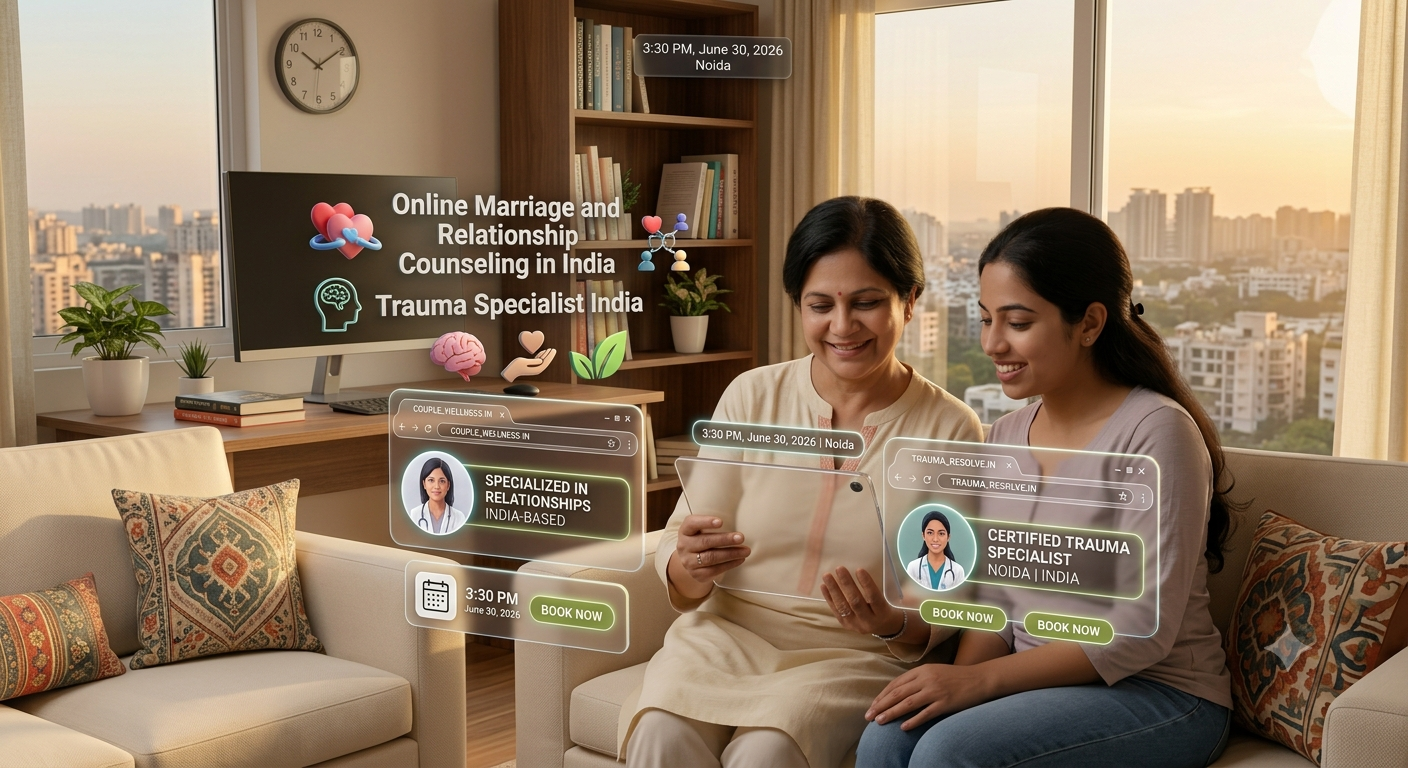
Relationships can go through difficult phases even when two people care deeply about each other. Communication may break down, recurring arguments can become exhausting, trust may be affected by past experiences, or one partner may feel emotionally disconnected.
In such situations, online marriage and relationship counseling in India can provide a structured and confidential space to understand what is happening and work towards healthier patterns.
Online counselling can be particularly useful for couples living in different cities, working demanding schedules, travelling frequently, or simply feeling more comfortable discussing personal concerns from home.
What Is Online Marriage and Relationship Counseling?
Online marriage and relationship counselling is professional psychological support delivered through secure video sessions or other appropriate digital formats.
A qualified relationship counsellor or therapist may help couples work through concerns such as:
- Frequent arguments and communication difficulties
- Emotional distance or loss of connection
- Trust and relationship concerns
- Conflict around finances, family or parenting
- Premarital concerns
- Relationship changes after marriage
- Separation or reconciliation decisions
- Infidelity and rebuilding trust
- Differences in expectations or lifestyles
- Difficulties adjusting to major life changes
The purpose is not simply to decide who is right or wrong. Effective couples counselling focuses on understanding relationship patterns, improving communication and helping partners make informed decisions about their relationship.
How Does Online Couples Counselling Work?
The exact process varies between therapists, but a typical online session may involve:
1. Initial assessment
The therapist learns about the couple’s concerns, relationship history and goals.
2. Identifying recurring patterns
Rather than focusing only on individual arguments, the therapist may explore what repeatedly triggers conflict and how both partners respond.
3. Improving communication
Couples can learn practical ways to express concerns, listen actively and discuss sensitive subjects without immediately escalating the conversation.
4. Working on underlying issues
Depending on the situation, sessions may explore trust, attachment, unresolved experiences, expectations, boundaries or emotional needs.
5. Developing healthier patterns
The couple may practise communication and conflict-management strategies between sessions and review their progress during subsequent appointments.
Is Online Marriage Counselling Effective?
Online counselling can be a convenient way to access professional relationship support, particularly when attending an in-person clinic is difficult.
However, the suitability of online therapy depends on the couple’s circumstances, the therapist’s qualifications and the nature of the concerns involved. A responsible professional should also recognise when online counselling is not the appropriate format and recommend additional or alternative support when necessary.
For couples considering therapy, the quality of the therapeutic relationship matters more than simply choosing the most convenient online service.
When Should Couples Consider Relationship Counselling?
You do not necessarily need to wait until a relationship reaches a crisis point.
Counselling may be worth considering when:
- The same disagreement keeps happening without resolution.
- Conversations regularly turn into criticism, defensiveness or withdrawal.
- You feel unheard or emotionally disconnected.
- Trust has been damaged.
- Major decisions are creating ongoing conflict.
- You are struggling to adjust to marriage, parenthood or another major transition.
- You want to improve your relationship before problems become more serious.
For example, a couple may argue repeatedly about household responsibilities. The visible disagreement may be about chores, but the underlying issue could involve feeling unappreciated, unsupported or unheard. A therapist can help identify that deeper pattern rather than simply suggesting another way to divide the chores.
Can Couples Attend Therapy Online From Different Cities?
Yes. Online relationship counselling can make it possible for partners to attend sessions even when they are not in the same location, subject to the therapist’s policies and the suitability of the arrangement.
This can be useful for couples who:
- Live in different cities
- Have demanding work schedules
- Travel regularly
- Are temporarily living apart
- Prefer the privacy of their own home
Couples should discuss practical arrangements with the therapist before beginning sessions, including confidentiality, technology requirements and whether joint or individual sessions may be appropriate.
What If Relationship Problems Are Connected to Past Trauma?
Relationship difficulties sometimes overlap with unresolved traumatic experiences. A person’s past experiences can influence trust, emotional responses, boundaries, attachment and reactions during conflict.
In these situations, searching for a trauma specialist in India may be more appropriate than choosing a therapist solely because they describe themselves as a couples counsellor.
A trauma-informed professional can consider how past experiences may affect present emotional responses without assuming that every relationship difficulty is caused by trauma.
When looking for a trauma-focused therapist, consider:
- Relevant professional qualifications
- Specific training in trauma-focused approaches
- Experience with concerns similar to yours
- Clear explanations of confidentiality and treatment boundaries
- Whether the professional works with individuals, couples or both
- Whether online sessions are appropriate for your circumstances
Can Trauma Therapy and Couples Counselling Be Combined?
Sometimes, but it should be assessed individually.
For example, one partner may have unresolved personal experiences that make certain relationship situations particularly difficult. Addressing those individual concerns may support healthier relationship communication.
However, couples therapy and individual trauma work have different goals. A qualified professional should determine whether joint sessions, individual therapy, or a combination is suitable rather than automatically combining approaches.
How to Choose the Right Online Relationship Counsellor in India
Choosing a therapist is an important decision. Do not select someone solely because they appear high in search results or have an attractive website.
1. Check professional credentials
Look for relevant professional qualifications, training and experience. If appropriate, verify registration or professional standing through the relevant Indian professional bodies.
2. Look for relationship-specific experience
A therapist who regularly works with couples may have greater familiarity with relationship dynamics than someone whose practice is focused primarily on unrelated concerns.
3. Consider the therapist’s approach
Different therapists use different evidence-informed approaches. Ask how they typically work with couples and whether their approach fits your goals.
4. Assess communication and comfort
Both partners should ideally feel that the therapist can listen without automatically taking sides.
5. Ask about confidentiality
Before beginning online therapy, understand how sessions are conducted, what information is recorded, and how privacy is handled.
6. Confirm practical details
Ask about session duration, fees, cancellation policies, availability and whether sessions are conducted individually, jointly or in both formats.
Questions to Ask Before Booking Online Couples Counselling
A short initial conversation can help you determine whether a therapist is suitable.
Consider asking:
Do you regularly work with married couples or partners in long-term relationships?
What happens during the first session?
Do you offer individual sessions as well as joint sessions?
How do you approach recurring conflict or communication problems?
What happens if one partner is reluctant to attend?
Is online counselling appropriate for our particular situation?
How do you maintain confidentiality during online sessions?
These questions can help you make a more informed decision instead of choosing a provider based solely on price or availability.
Online Marriage and Relationship Counseling in India: What to Expect
The first session is generally about understanding the concerns rather than immediately solving every problem.
You may discuss:
- How long the relationship difficulties have been present
- Major sources of conflict
- Communication patterns
- Previous attempts to resolve the problem
- Individual and shared expectations
- What each partner wants from counselling
It is normal for conversations to feel uncomfortable at times. Relationship therapy may involve discussing subjects that couples have avoided for months or years.
A good therapist should create a professional environment where difficult issues can be explored respectfully.
Is Couples Counselling Only for Relationships in Crisis?
No.
Some couples seek therapy because they are experiencing serious problems. Others use counselling to improve communication, prepare for marriage, navigate a major transition or address smaller concerns before they become entrenched patterns.
Premarital counselling, for example, can give couples an opportunity to discuss expectations around finances, family boundaries, communication, parenting and future plans.
What About Individual Counselling?
Not every relationship problem needs to be addressed exclusively as a couple.
Individual therapy can sometimes be appropriate when one partner is dealing with personal concerns that affect the relationship, such as unresolved emotional experiences, anxiety, grief, self-esteem difficulties or trauma-related responses.
A therapist can help determine whether individual support, couples counselling or both would be appropriate.
When Online Counselling May Not Be the Right Option
Online therapy is not automatically suitable for every situation.
If there is immediate danger, ongoing violence, coercive control, serious safety concerns or another urgent situation, couples counselling should not be treated as a substitute for appropriate safety planning or specialist intervention.
Similarly, some situations may benefit from face-to-face assessment or more specialised services.
A responsible therapist should prioritise safety and appropriate care rather than trying to keep every client in an online counselling format.
How to Make Online Couples Therapy More Productive
You can improve the quality of your sessions with a few practical steps:
- Attend from a private location.
- Use a reliable internet connection and headphones where appropriate.
- Avoid attending while driving or multitasking.
- Allow enough uninterrupted time before and after the session.
- Agree not to record sessions unless everyone involved and the therapist have explicitly agreed.
- Try to listen rather than preparing a rebuttal while your partner is speaking.
- Be honest about your goals for counselling.
- Complete agreed exercises or reflections between sessions.
Small practical details can make online sessions considerably easier to manage.
Frequently Asked Questions
What is the best online marriage and relationship counselling in India?
There is no single therapist or service that is best for every couple. The right choice depends on the concerns involved, the therapist’s qualifications and experience, their therapeutic approach, availability and whether both partners feel comfortable working with them.
Can relationship counselling save a marriage?
Counselling cannot guarantee a particular outcome. It can provide a structured environment for couples to understand relationship difficulties, communicate more effectively and consider their options. The outcome depends on the circumstances and the willingness of the people involved to participate in the process.
Can only one partner attend relationship counselling?
Yes, individual counselling can sometimes be useful even when the other partner does not participate. A therapist can help the individual understand their own responses, communication patterns and choices. However, the approach will differ from joint couples therapy.
How long does couples counselling take?
There is no universal number of sessions. Some couples may want help with a specific issue, while others have longstanding relationship difficulties requiring more sustained support. The therapist should discuss goals and review progress rather than promising a fixed result.
Is online counselling confidential?
Therapists generally have professional confidentiality obligations, but clients should ask their chosen professional how confidentiality is handled specifically in online sessions. Clients should also participate from a private environment and use appropriate security practices.
How can I find a trauma specialist in India?
Start by looking for a qualified mental-health professional with specific training and experience in trauma-focused work. Check professional credentials, therapeutic approach, experience, online-session policies and whether their services match your particular needs.