
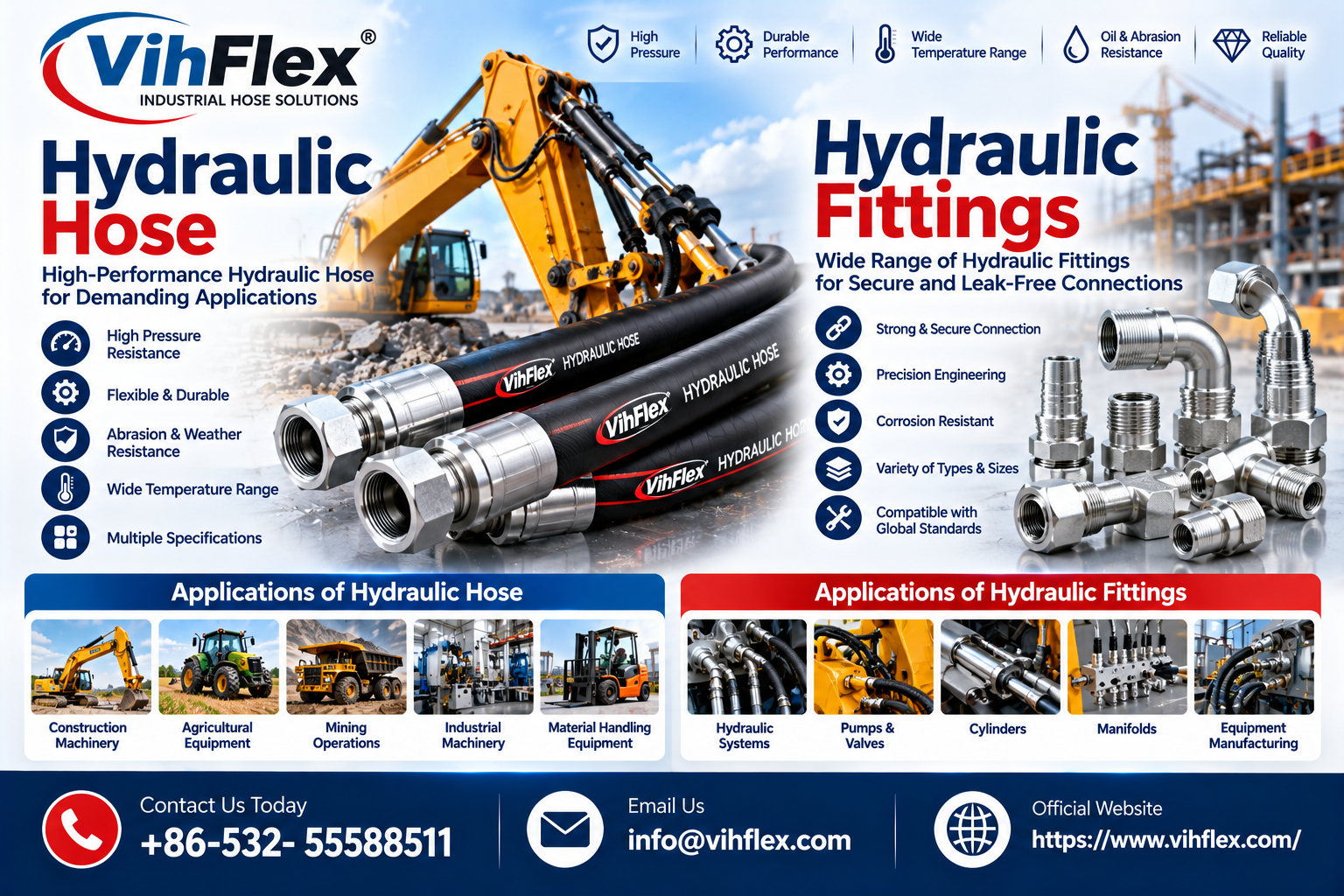
From construction equipment and agricultural machinery to manufacturing systems, hydraulic technology supports controlled movement, lifting, pressing, and other mechanical functions.
At the centre of these systems are two essential components: Hydraulic Hose and Hydraulic Fittings.
A hydraulic hose provides a flexible pathway for pressurised hydraulic fluid, while fittings connect the hose assembly to pumps, valves, cylinders, and other equipment.
Although these components may appear relatively simple, their compatibility directly influences equipment performance, maintenance requirements, and operational safety.
Industrial buyers are therefore placing greater attention on complete hydraulic hose assemblies rather than evaluating individual components separately.
Understanding the relationship between hoses, fittings, and system requirements can help businesses improve equipment reliability and make more informed purchasing decisions.
Why Hydraulic Connections Matter in Industrial Machinery
Hydraulic systems use pressurised fluid to transmit power between interconnected components.
The performance of these systems depends on suitable fluid pathways, properly selected connections, and controlled operating conditions.
A poorly matched hose and fitting combination can create leakage, pressure losses, premature component wear, or dangerous system failures.
Consequently, hydraulic connection design should be considered during equipment planning rather than treated as a minor maintenance detail.
This principle encourages engineers and procurement teams to evaluate the complete assembly.
Understanding Hydraulic Hose Construction
A Hydraulic Hose is a flexible fluid-transfer component designed for specified hydraulic applications.
Typical construction includes an inner tube, reinforcement layers, and an external protective cover.
Each layer performs an important function.
The inner tube must be compatible with the hydraulic fluid being transported.
Reinforcement helps the hose withstand its rated operating pressure.
The outer cover provides protection against relevant environmental exposure and external wear.
Different hoses may use textile reinforcement, steel wire braiding, spiral wire reinforcement, or other application-specific constructions.
However, hose construction alone does not determine suitability.
Pressure ratings, temperature limits, fluid compatibility, and installation requirements must also be verified.
What Are Hydraulic Fittings?
Hydraulic Fittings are connection components used to join hydraulic hoses with equipment ports, tubing, or other hydraulic system components.
They help create suitable connections while supporting the controlled transfer of pressurised fluid.
Depending on the system, fittings may include straight connectors, elbows, adapters, flanges, and other specialised connection designs.
Different fitting systems use different thread forms, sealing arrangements, and connection standards.
These differences are important because visually similar fittings may not be interchangeable.
For example, matching thread diameter does not necessarily confirm that two fittings use compatible sealing methods.
Incorrect combinations can compromise connection integrity.
Why Hose and Fitting Compatibility Is Essential
The relationship between a hose and its fittings is one of the most important aspects of hydraulic assembly design.
A suitable hose must be paired with end fittings and attachment methods approved for that specific hose system.
Crimping dimensions, fitting insertion requirements, and assembly procedures depend on the manufacturer’s specifications.
Mixing unapproved hose and fitting components may produce an assembly that does not perform as expected.
Businesses should therefore confirm the suitability of the entire assembly before installation.
The assembly’s allowable pressure must not exceed the rating of its lowest-rated component.
How Hydraulic Connections Influence Equipment Efficiency
Hydraulic equipment operates most effectively when components are correctly selected and installed.
Improper hose routing can introduce unnecessary bending, twisting, or mechanical stress.
Poorly designed connections may also complicate maintenance and increase the likelihood of premature wear.
Correctly routed hoses and suitable fittings help maintain the intended fluid pathway.
Equipment designers should consider movement, vibration, clearance, and service access when planning connections.
These considerations are particularly important for mobile equipment, where hydraulic components move during normal operation.
Improving connection design can support more dependable equipment operation without unnecessarily increasing system complexity.
Common Hydraulic Connection Challenges
Industrial maintenance teams frequently encounter problems related to component selection and installation.
Common concerns include:
- Incorrect Fitting Selection: Incompatible thread or sealing arrangements.
- Excessive Hose Bending: Installation below the specified minimum bend radius.
- Hose Twisting: Mechanical stress caused by improper orientation.
- Vibration Exposure: Repeated movement affecting connections and supporting components.
- Fluid Contamination: Unwanted particles entering the hydraulic circuit.
- Improper Assembly: Incorrect fitting attachment or installation procedures.
- External Abrasion: Damage caused by contact with surrounding machinery.
Identifying these conditions can help maintenance teams improve system reliability.
Why Standardisation Supports Industrial Maintenance
Hydraulic equipment fleets may contain multiple hose sizes, connection types, and pressure classifications.
Without suitable component identification, maintenance teams can experience difficulties sourcing correct replacements.
Standardising approved hose assemblies where technically appropriate can simplify maintenance planning.
Clear specifications also help purchasing departments avoid ordering incompatible parts.
Businesses may maintain records covering hose dimensions, approved fitting references, operating requirements, and equipment applications.
However, standardisation should never override the specific engineering requirements of a hydraulic system.
The objective is to improve consistency while preserving technical compatibility.
Selecting the Right Hydraulic Hose and Fittings
Choosing suitable components requires coordination between engineering, maintenance, and procurement teams.
A practical selection process should include:
- Operating Pressure: Verify maximum working conditions and relevant pressure fluctuations.
- Fluid Compatibility: Confirm compatibility with the hydraulic medium.
- Temperature Requirements: Check fluid and environmental temperature limits.
- Connection Standards: Identify the correct fitting and sealing specifications.
- Mechanical Movement: Consider routing, vibration, bending, and twisting.
- Assembly Validation: Follow approved manufacturing and installation procedures.
- Maintenance Accessibility: Ensure components can be inspected and replaced appropriately.
These factors help reduce uncertainty when selecting industrial hydraulic components.
Why Hydraulic Maintenance Requires Safety Awareness
Hydraulic systems may retain dangerous pressure even after equipment has stopped operating.
Damaged hoses and leaking connections can create serious hazards.
High-pressure hydraulic fluid can penetrate the skin and cause severe injury.
Operators should never use their hands to locate suspected leaks.
Inspection and maintenance must follow the equipment manufacturer’s safety procedures, including appropriate isolation and pressure relief.
Hose assemblies showing significant damage, leakage, or other defects should be assessed by qualified personnel.
Proper handling and maintenance are essential parts of responsible hydraulic system operation.
Frequently Asked Questions (FAQs)
1. What is a Hydraulic Hose used for?
A hydraulic hose transfers pressurised hydraulic fluid between suitable components in industrial machinery, construction equipment, agricultural systems, and other hydraulic applications.
2. What are Hydraulic Fittings?
Hydraulic fittings are connection components that join hoses, tubing, and hydraulic equipment while providing appropriate fluid-transfer connections.
3. Can different hydraulic hose and fitting brands be combined?
Only when the combination is specifically approved and validated for the intended assembly. Unverified component combinations should not be assumed compatible.
4. What causes hydraulic hose connection failures?
Potential causes include unsuitable components, incorrect assembly, excessive bending, vibration, abrasion, pressure exposure, and improper maintenance.
5. How can businesses choose reliable hydraulic components?
Businesses should verify technical specifications, pressure ratings, connection compatibility, fluid requirements, approved assembly procedures, and supplier documentation.
Media Contact
Department: Hydraulic Hose and Industrial Connection Enquiries
Contact: +86-532-55588511
Email: info@vihflex.com
Official Website: https://www.vihflex.com/
Read More:-