
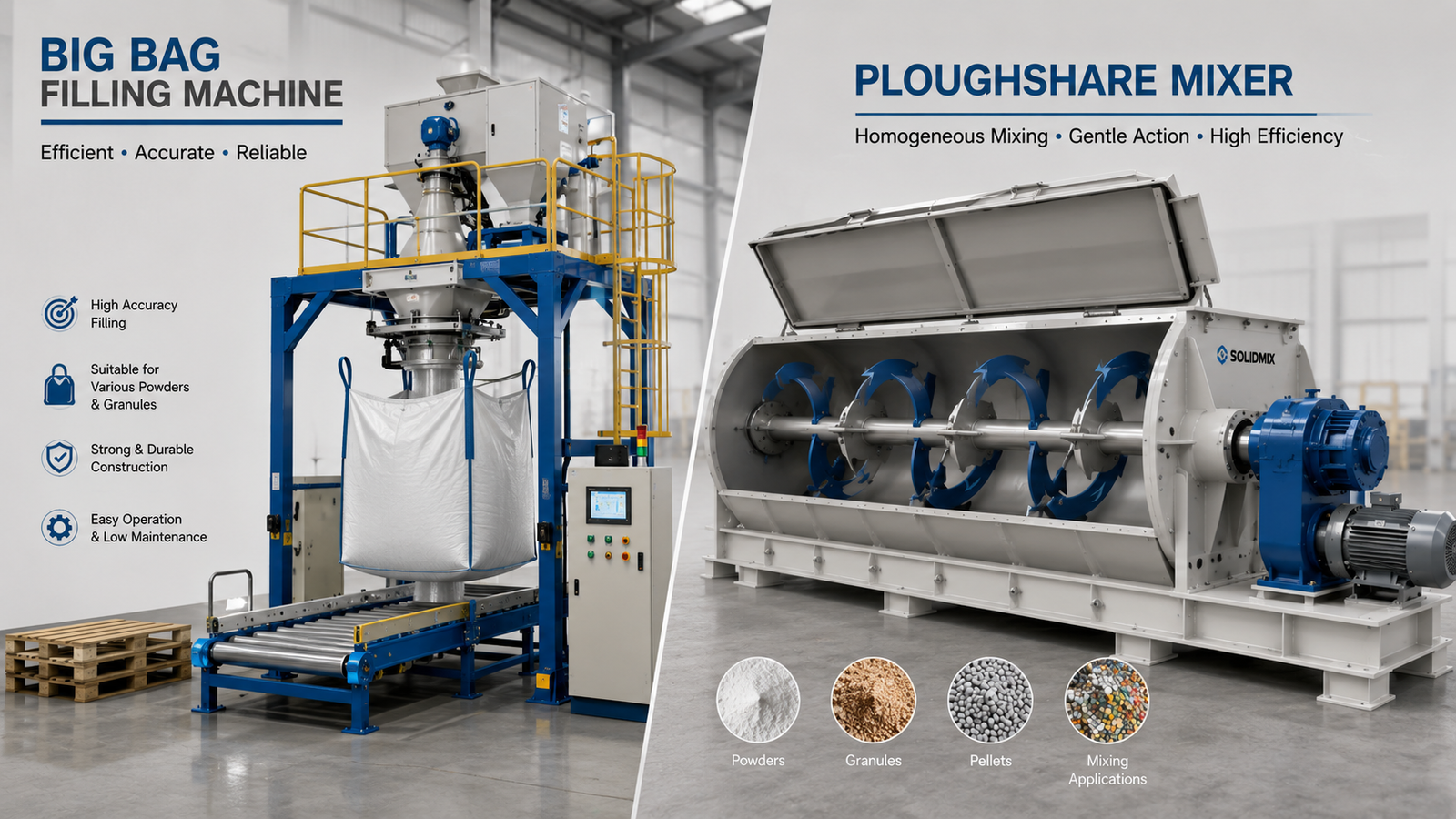
A big bag filling machine is designed to fill flexible intermediate bulk containers (FIBCs), commonly called big bags or bulk bags, with powders, granules, pellets and other dry bulk materials. For manufacturers handling significant volumes, the right filling system can improve consistency, reduce material loss and make bag handling considerably easier.
However, choosing a machine is not simply a matter of selecting a model based on bag capacity. The material being filled, required throughput, dust characteristics, weighing accuracy, bag dimensions and upstream equipment all affect the right configuration.
This guide explains what to consider before investing in a big bag filling machine, including how it can work alongside equipment such as a ploughshare mixer.
What is a big bag filling machine?
A big bag filling machine is an industrial system used to fill FIBCs with a controlled quantity of bulk material.
A typical system may include:
· A bag support frame
· Bag lifting or weighing arrangements
· Filling spout and connection system
· Material inlet or feeding hopper
· Weighing/load-cell system
· Dust extraction or containment equipment
· Vibrating or densification equipment
· Controls and safety interlocks
Depending on the application, the machine can be configured for gravimetric filling, volumetric filling or a combination of feeding and weighing technologies.
In simple terms: the machine holds the bulk bag securely, introduces the material at a controlled rate and stops or changes the feed when the target fill weight is reached.
Why use a big bag filling machine?
Manual filling can become difficult when bags are large, filling quantities are consistent and production volumes increase.
An automated or semi-automated FIBC filling system can help manufacturers achieve a more controlled filling process while reducing manual handling.
Key considerations include:
1. Consistent filling
For products sold or processed by weight, accurate filling is important. A weighing system allows the operator to work towards a defined target weight rather than relying on visual estimation.
2. Improved material handling
A suitable bulk bag filling station provides a controlled interface between the material supply system and the FIBC.
This can be particularly useful for powders and fine materials where uncontrolled transfer can create dust or product loss.
3. Reduced manual handling
Supporting and filling large bags manually can place unnecessary demands on operators. Mechanical bag support, lifting arrangements and suitable controls can make the process easier to manage.
4. Better integration with production lines
A big bag filling machine does not have to operate as an isolated piece of equipment. It can be integrated with mixers, conveyors, hoppers, sieving systems, dust collectors and other process machinery.
That integration is often where the biggest practical benefits come from.
How does a big bag filling machine work?
Although designs vary, the operating sequence is generally straightforward.
1. The empty FIBC is positioned on the filling station.
2. The bag loops are attached to the support frame or lifting system.
3. The filling spout is connected to the bag inlet.
4. The material feed system begins charging the bag.
5. The weighing system monitors the increasing bag weight.
6. The feed rate may reduce near the target weight for improved control.
7. The material flow stops once the programmed target is reached.
8. The filled bag is released for removal or transferred to the next stage.
Some applications also use bag vibration or densification during filling. This can help settle the product and make better use of the available bag volume, depending on the characteristics of the material.
What materials can be filled into big bags?
Big bag filling systems are commonly used for dry bulk solids, but the machine configuration needs to match the product.
Potential applications include:
· Powders
· Granules
· Pellets
· Crystalline materials
· Mineral products
· Chemical powders
· Food ingredients
· Agricultural products
· Plastic compounds
· Building and construction materials
The material’s flowability, bulk density, particle size, moisture content, aeration behaviour and dustiness should all be assessed before selecting the filling equipment.
A free-flowing granule, for example, may require a substantially different feeding arrangement from a fine cohesive powder.
Big bag filling machine with weighing system
For many industrial applications, weighing is one of the most important parts of the filling system.
Load cells positioned beneath the bag support structure can measure the weight of the FIBC during filling. The control system can then regulate the material feed according to the required target.
A two-stage filling approach is often useful:
Fast feed: Material enters the bag rapidly during the early part of the cycle.
Fine feed: The feed rate is reduced as the target weight approaches.
This approach can help balance filling speed with weight control.
The correct system should nevertheless be selected around the actual product and required accuracy rather than assuming that one weighing arrangement will suit every application.
Choosing the right big bag filling machine
Before requesting a quotation, establish the following specifications.
Bag dimensions and capacity
Determine:
· Maximum and minimum bag dimensions
· Target filling weight
· Bag inlet design
· Bag outlet requirements
· Number and arrangement of lifting loops
· Disposable or reusable FIBC construction
The filling frame needs to accommodate the bags safely without creating unnecessary adjustment or handling problems.
Required production rate
Think beyond the nominal machine capacity.
Calculate the required bags per hour and consider the complete cycle:
Bag positioning + filling + settling/densification + disconnection + bag removal
A machine that can theoretically deliver a high filling rate may not achieve the desired production output if bag handling becomes the bottleneck.
Product characteristics
Provide the equipment supplier with representative product information where possible.
Important properties include:
· Bulk density
· Particle size distribution
· Flowability
· Moisture content
· Dust generation
· Product temperature
· Abrasiveness
· Hygroscopic behaviour
Testing with the actual product can be particularly valuable when handling difficult powders.
Dust control
Fine powders can generate airborne dust during filling. Depending on the material, a filling system may require a contained filling connection and extraction arrangement.
Dust control should be considered as part of the overall process design rather than added as an afterthought.
Cleaning and hygiene
For food, pharmaceutical or sensitive chemical applications, accessibility and cleaning requirements can significantly influence the design.
Consider:
· Product-contact materials
· Surface finishes
· Access for cleaning
· Product retention points
· Changeover requirements
· Sealing arrangements
The right specification depends on the applicable industry and site standards.
Where does a ploughshare mixer fit into the process?
A ploughshare mixer is commonly used for intensive mixing of powders and other bulk solids. It can form part of a wider production system in which blended material is subsequently transferred to a big bag filling station.
A simplified process might look like this:
Raw materials → Ploughshare mixer → Discharge system → Conveyor or hopper → Big bag filling machine → Filled FIBC
The mixer and filling machine perform different jobs.
The ploughshare mixer focuses on producing a homogeneous blend, while the big bag filling machine focuses on controlled packaging of the finished bulk material.
This distinction matters when designing the complete line. The discharge characteristics of the mixer, intermediate storage capacity and material flow behaviour can all affect the filling station.
Can a ploughshare mixer discharge directly into a big bag filling machine?
Potentially, yes, but the connection needs to be engineered around the process.
The mixer may discharge into an intermediate hopper, buffer vessel or feeding system before the material reaches the FIBC filling station. This can help decouple the mixing cycle from the bag-filling cycle.
For example, if the mixer completes a batch faster than one bag can be filled, a suitable buffer can prevent the two operations from unnecessarily holding each other up.
The exact arrangement depends on:
· Mixer batch size
· Filling weight
· Filling cycle time
· Product flowability
· Required production rate
· Available space
· Dust-control requirements
· Whether continuous or batch operation is required
Big bag filling machine vs manual filling
| Factor | Manual filling | Big bag filling system |
| Operator involvement | Higher | Lower, depending on automation |
| Fill-weight control | Operator-dependent | Can use integrated weighing |
| Material containment | More difficult to control consistently | Can be designed for contained filling |
| Repeatability | Variable | More consistent when correctly configured |
| Integration | Limited | Can integrate with upstream/downstream equipment |
| Suitable production scale | Smaller or occasional operations | Regular bulk production |
Automation is not automatically the right answer for every business. For low-volume operations, a simpler system may be more economical. For higher-volume or more demanding applications, however, controlled bulk bag filling can provide a more scalable solution.
What should you ask a big bag filling machine supplier?
A useful supplier discussion should go beyond asking, “What is the price of the machine?”
Ask about:
1. What products has the machine been designed to handle?
2. Can the system be tested with our actual material?
3. What filling accuracy can reasonably be expected for our product?
4. What bag sizes and filling weights can it accommodate?
5. What is the expected cycle time under our operating conditions?
6. How is dust controlled during filling?
7. How is the filled bag removed?
8. Can the machine integrate with our existing mixer, hopper or conveyor?
9. What maintenance access is required?
10. Which components are standard and which are application-specific?
11. What electrical, pneumatic and utility requirements are needed?
12. What commissioning and after-sales support is provided?
A supplier that asks detailed questions about your product and process is generally better placed to recommend an appropriate configuration than one that quotes a machine based solely on bag capacity.
How much does a big bag filling machine cost?
There is no meaningful single price for a big bag filling machine because the final specification can vary considerably.
Cost can be influenced by:
· Filling capacity
· Automation level
· Weighing system
· Bag handling arrangement
· Dust extraction
· Product-contact materials
· Stainless-steel construction
· ATEX or other hazardous-area requirements, where applicable
· Integration with existing equipment
· Controls and instrumentation
· Custom engineering
For this reason, obtaining a quotation based on your actual product, bag specification and production requirements is more useful than comparing headline machine prices.
Common mistakes when selecting FIBC filling equipment
Focusing only on filling speed
A high theoretical filling rate is not useful if the rest of the process cannot keep up.
Ignoring product flow behaviour
Equipment designed for free-flowing granules may perform poorly with cohesive powders if the feeding arrangement is unsuitable.
Treating dust extraction as an optional extra
For dusty materials, containment and extraction should be incorporated into the process design from the beginning.
Not considering bag removal
Filling is only one part of the cycle. Operators also need to attach, release and move filled bags safely and efficiently.
Designing equipment in isolation
If the filling machine is connected to a mixer, conveyor or process hopper, the interfaces between the machines need to be considered during the engineering stage.
Frequently asked questions
What is the purpose of a big bag filling machine?
A big bag filling machine fills FIBCs with a controlled quantity of bulk material. Depending on the design, it can incorporate weighing, dust containment, bag support, product densification and automated controls.
What is an FIBC?
FIBC stands for Flexible Intermediate Bulk Container. These large flexible containers are commonly used to store and transport dry bulk solids such as powders and granules.
Is a big bag filling machine suitable for powders?
Yes, but the equipment must be designed for the specific powder. Cohesive, dusty or poorly flowing powders may require specialised feeding, aeration, vibration or dust-control arrangements.
Can the machine weigh the product?
Many big bag filling systems incorporate load cells or another weighing arrangement so that the filling cycle can be controlled against a target weight.
What is a ploughshare mixer used for?
A ploughshare mixer is used to intensively mix dry powders, granules and other bulk solids. It can be incorporated upstream of a bulk bag filling system when the finished blend needs to be packed into FIBCs.
How do I choose the correct machine?
Start with the material characteristics, bag dimensions, target filling weight, required production rate and site requirements. Then discuss the complete process with an equipment supplier and, where appropriate, arrange product trials.
Choosing a system for your application
The best big bag filling machine is not necessarily the most automated or highest-capacity model. It is the system that fits the material, bag, production process and operating environment without creating new bottlenecks.