
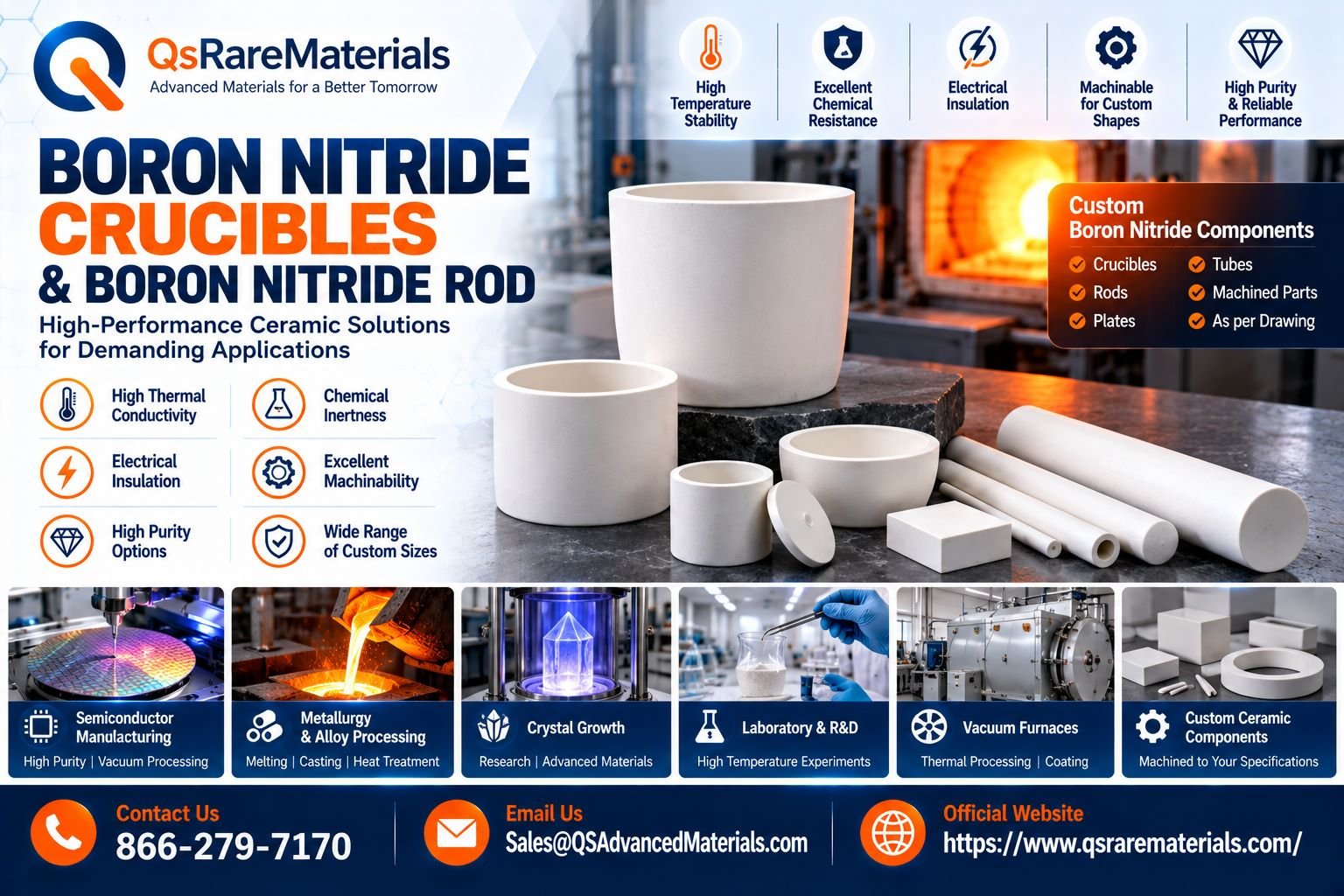
Powder metallurgy research is creating new opportunities for specialised ceramic materials as manufacturers investigate improved methods for processing metal powders, developing advanced alloys, and producing high-performance industrial components.
In powder-based manufacturing, material purity, temperature control, and processing conditions can strongly influence the properties of finished products.
Boron Nitride Crucibles provide specialised ceramic containment options for selected thermal processing and experimental materials applications.
Meanwhile, a Boron Nitride Rod can be machined into insulating supports, positioning fixtures, and customised ceramic components used in compatible laboratory equipment.
Both products offer different engineering functions, but their appropriate selection can support controlled experimentation and reliable material handling.
For powder metallurgy laboratories, research institutions, and advanced manufacturing companies, understanding technical ceramic properties can help improve processing decisions and component compatibility.
Why Powder Metallurgy Requires Specialised Processing Materials
Powder metallurgy involves manufacturing or investigating materials using powdered metals, alloys, or other suitable substances.
Depending on the process, powders may undergo compaction, heating, sintering, or additional treatment.
The properties of the finished material depend on factors including particle characteristics, processing atmosphere, temperature distribution, and chemical composition.
Equipment materials can introduce additional variables.
Suitable ceramic components may help researchers establish more consistent experimental conditions.
What Are Boron Nitride Crucibles?
Boron Nitride Crucibles are specialised ceramic containers manufactured using suitable boron nitride materials.
Hexagonal boron nitride is recognised for its electrical insulation characteristics, distinctive thermal properties, and compatibility with selected substances.
Depending on their grade, crucibles may be considered for controlled-atmosphere material processing, laboratory experiments, and specialised thermal applications.
Their suitability depends on chemical exposure, operating temperature, and equipment configuration.
Not every boron nitride grade performs identically, and certain processing materials may react with boron nitride.
Laboratories should therefore verify compatibility before using a crucible in critical experiments.
What Is a Boron Nitride Rod?
A Boron Nitride Rod is a solid technical ceramic component that may be used directly or machined into specialised parts.
Depending on its composition and manufacturing method, it can support applications involving electrical insulation, positioning, and thermal equipment fixtures.
For powder processing equipment, appropriate ceramic rods may be considered for spacers or supports where their mechanical and environmental properties are suitable.
However, boron nitride ceramics are generally brittle compared with metals.
Designers must consider component dimensions, mechanical loading, and thermal conditions before selecting them.
Why Powder Contamination Is an Important Concern
Powder-based materials can be sensitive to unwanted chemical additions.
Contamination may originate from processing vessels, handling tools, fixtures, or the surrounding environment.
In certain experiments, even relatively small compositional changes can affect the interpretation of material properties.
High-purity ceramic components may help manage selected contamination risks.
However, ceramic purity does not automatically establish compatibility with every powder.
Researchers should evaluate the interaction between the powder and its processing environment.
Ceramic Containers in Experimental Thermal Processing
Experimental processing may involve loose powders, compacted specimens, or materials prepared for subsequent thermal treatment.
Suitable containers help maintain the intended placement of materials within processing equipment.
A ceramic crucible must offer appropriate capacity, geometry, and chemical compatibility for the intended procedure.
Wall thickness and container shape may influence thermal behaviour.
Researchers should also consider whether processing gases, decomposition products, or other substances could interact with the ceramic.
Representative experiments can help determine whether the proposed container is suitable.
Comparing Crucibles and Ceramic Rods
| Engineering Requirement | Boron Nitride Crucibles | Boron Nitride Rod |
| Primary Function | Material containment | Support and insulation |
| Typical Geometry | Hollow ceramic container | Solid ceramic stock |
| Design Priority | Capacity and wall thickness | Diameter and machined dimensions |
| Processing Consideration | Powder and chemical compatibility | Fixture strength and stability |
| Main Limitation | Atmosphere-dependent performance | Brittle mechanical behaviour |
| Quality Requirement | Surface integrity and purity | Dimensional accuracy and material grade |
The appropriate component depends on the intended manufacturing function.
Understanding Sintering Atmosphere Compatibility
Sintering involves heating suitable powdered or compacted materials to promote bonding and densification without necessarily melting the entire material.
Processing atmosphere can influence oxidation, reactions, and other material characteristics.
Depending on the application, equipment may use vacuum or specifically controlled gases.
Boron nitride components must be assessed against these conditions.
Exposure to oxygen at elevated temperatures can limit the suitability of certain grades.
Other reactive substances may also affect ceramic performance.
Manufacturers should confirm technical specifications for the actual process atmosphere rather than relying on general temperature claims.
Designing Stable Fixtures for Research Equipment
Precision positioning can help laboratories maintain consistent experimental arrangements.
Suitable ceramic supports may provide separation between compatible components or maintain designated locations within a furnace.
Machined boron nitride rods can offer design flexibility for selected fixture requirements.
However, loading conditions must remain within the component’s capabilities.
Excessive clamping pressure or unsupported lengths may increase fracture risks.
Engineers should consider thermal expansion, contact geometry, and assembly access when developing specialised fixtures.
The Importance of Material Grade and Density
Commercial boron nitride products can differ in purity, density, additives, and manufacturing methods.
These variations influence properties such as machinability, mechanical strength, and chemical compatibility.
A grade suitable for a ceramic spacer may not be appropriate for direct contact with a particular powder composition.
Buyers should request relevant technical information before selecting components.
Material identification is particularly important when experiments involve sensitive chemical compositions.
Documented specifications help research teams maintain consistent procurement requirements.
Quality Testing and Experimental Verification
Before approving technical ceramic components, laboratories should examine representative samples.
Inspection may include dimensional measurements, visible surface condition, and material identification.
For processing vessels, chemical compatibility trials may be necessary.
Fixture components should also be evaluated for mechanical suitability under their intended operating conditions.
After experimental processing, researchers may examine ceramic surfaces for deposits, reactions, or visible damage.
These observations can help determine whether the components remain appropriate for additional use.
Choosing Suitable Boron Nitride Components
Industrial buyers should evaluate several important requirements:
- Material Composition: Confirm grade, purity, and relevant additives.
- Processing Conditions: Review temperature, atmosphere, and chemical exposure.
- Component Dimensions: Establish suitable geometry and tolerances.
- Mechanical Requirements: Evaluate support loads and handling conditions.
- Quality Documentation: Request appropriate material and inspection information.
- Customisation: Confirm whether specialised shapes can be manufactured.
Clear technical communication supports informed material selection and reduces avoidable procurement problems.
Frequently Asked Questions (FAQs)
1. What are Boron Nitride Crucibles used for?
They are specialised ceramic containers used in selected laboratory experiments, thermal processing operations, and advanced material development applications.
2. What is a Boron Nitride Rod used for?
It may be machined into ceramic supports, electrical insulators, spacers, and specialised components for compatible engineering equipment.
3. Can boron nitride crucibles be used in powder metallurgy research?
Certain grades may be suitable for selected powder processing applications, depending on material compatibility, atmosphere, and temperature.
4. Are boron nitride ceramics suitable for sintering equipment?
They may be appropriate for selected sintering applications, but their performance must be evaluated against the actual operating environment.
5. How should manufacturers select boron nitride ceramic products?
Manufacturers should consider material grade, chemical compatibility, thermal conditions, geometry, mechanical requirements, and quality documentation.
Media Contact
Department: Advanced Ceramic Materials and Industrial Product Enquiries
Phone: 866-279-7170
Email: Sales@QSAdvancedMaterials.com
Official Website: https://www.qsrarematerials.com/