
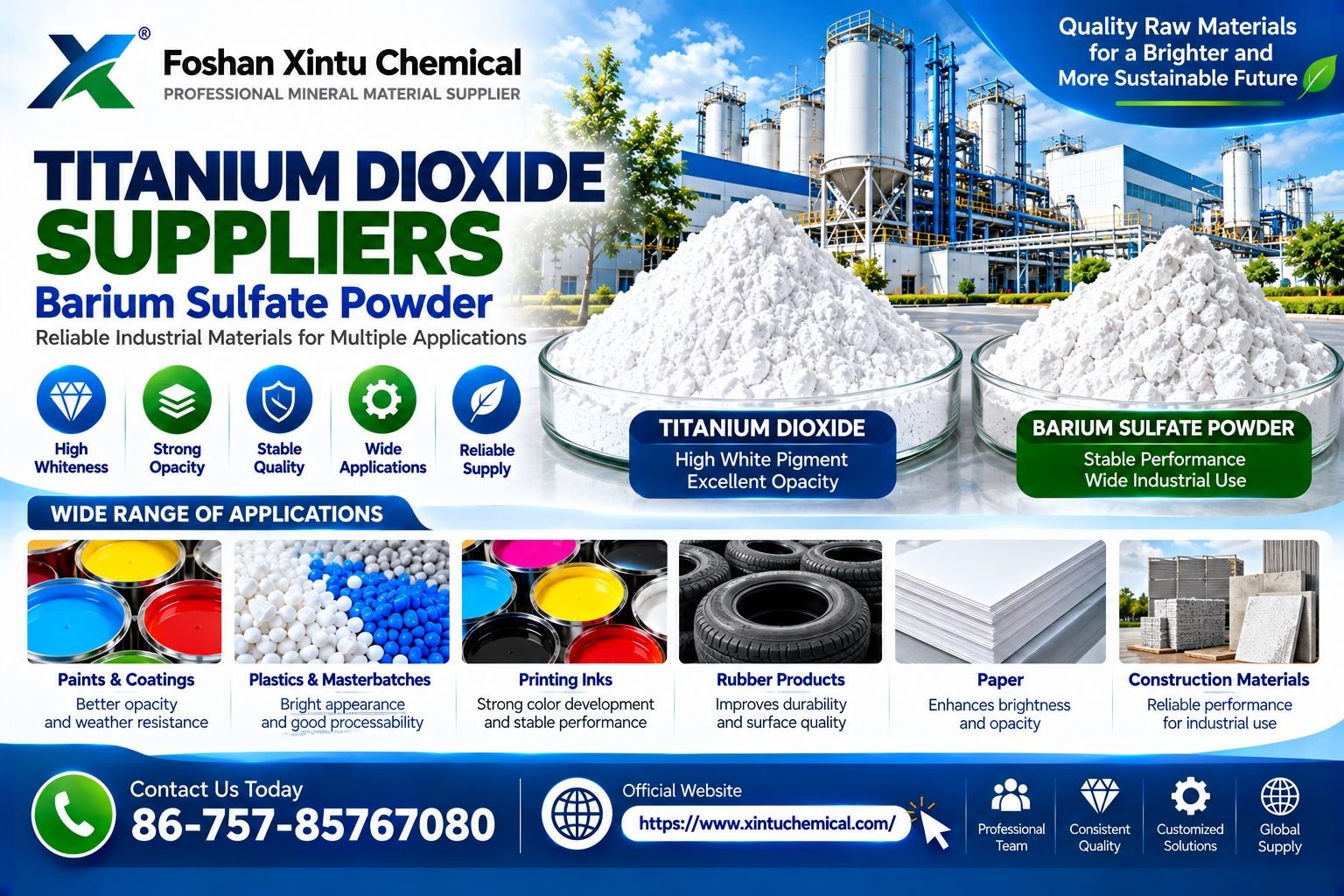
As industrial manufacturers focus on controlling raw material costs, improving formulation consistency, and maintaining product quality, the demand for dependable chemical sourcing solutions remains important. Professional Titanium Dioxide Suppliers support manufacturers requiring high-performance white pigments, while Barium Sulfate Powder provides functional filler solutions for paints, coatings, plastics, rubber, and specialty industrial applications.
Both materials serve important but different functions in manufacturing. Titanium dioxide is primarily valued for its whiteness and opacity, whereas barium sulfate contributes selected physical and processing characteristics.
For industrial buyers, understanding technical specifications, supplier capabilities, and formulation requirements is essential for making informed purchasing decisions.
Why Titanium Dioxide Suppliers Matter in Industrial Manufacturing
Titanium Dioxide Suppliers provide titanium dioxide pigments used in a wide range of commercial and industrial products.
Titanium dioxide, chemically represented as TiO₂, is widely recognized for its high refractive index, excellent whiteness, and strong light-scattering properties.
These characteristics make it valuable for applications requiring opacity and consistent visual appearance.
Major Applications of Titanium Dioxide
- Architectural Coatings: Supports whiteness and hiding power in suitable paint formulations.
- Industrial Coatings: Provides pigmentation for selected protective and decorative finishes.
- Plastic Manufacturing: Used in polymer compounds requiring white coloration.
- Printing Inks: Supports opacity and brightness in appropriate ink systems.
- Powder Coatings: Contributes to consistent color and visual performance.
- Specialty Products: Serves application-specific pigmentation requirements.
Understanding Barium Sulfate Powder and Its Properties
Barium Sulfate Powder is a finely divided inorganic compound with the chemical formula BaSO₄.
It is characterized by high density, very low water solubility, and chemical stability under many ordinary industrial conditions.
Industrial barium sulfate may be produced from natural barite or through controlled chemical precipitation.
The manufacturing method, purification process, and particle-size distribution influence its suitability for different applications.
Important Material Characteristics
High Density: Useful for products requiring specific weight or density characteristics.
Chemical Stability: Supports use in numerous compatible industrial formulations.
Particle-Size Options: Different grades offer different dispersion and processing behavior.
Whiteness: Suitable grades may contribute to the appearance of light-colored products.
Low Water Solubility: Helps maintain stability in appropriate applications.
Functional Versatility: Supports various coating, polymer, and industrial compound requirements.
Titanium Dioxide and Barium Sulfate: Understanding Their Different Functions
Although both materials are used in industrial formulations, they should not be considered direct substitutes.
| Property | Titanium Dioxide | Barium Sulfate Powder |
| Chemical formula | TiO₂ | BaSO₄ |
| Primary purpose | White pigmentation | Functional mineral filling |
| Optical characteristics | Strong light scattering | Lower hiding power |
| Main applications | Paints, plastics, inks | Coatings, plastics, rubber |
| Important specifications | Whiteness, dispersion, surface treatment | Purity, particle size, density |
| Purchasing priority | Pigment performance | Filler compatibility |
Understanding these differences helps manufacturers select appropriate materials without compromising finished-product requirements.
Improving Paint and Coating Formulations
Titanium dioxide and barium sulfate are both relevant to the coatings industry.
Titanium dioxide provides hiding power and contributes to white pigmentation, while barium sulfate can function as an extender or specialty filler.
Depending on the formulation, appropriate mineral selection may help manufacturers control surface texture, coating density, gloss, and processing characteristics.
However, excessive replacement of titanium dioxide with fillers may reduce opacity.
Laboratory testing is therefore necessary before changing ingredient concentrations.
Applications in Plastic and Polymer Manufacturing
Plastic processors use pigments and fillers to achieve specific material characteristics.
Titanium dioxide is commonly incorporated into suitable polypropylene, polyethylene, PVC, and other polymer formulations for white pigmentation.
Meanwhile, Barium Sulfate Powder may be added to selected compounds to adjust density, appearance, or other physical properties.
Applications include plastic masterbatches, molded components, industrial sheets, and specialized polymer products.
Manufacturers should evaluate particle dispersion, filler loading, processing temperatures, and mechanical performance.
The appropriate material combination depends on the finished product’s intended use.
What Industrial Buyers Should Expect From Titanium Dioxide Suppliers
Selecting reliable Titanium Dioxide Suppliers involves more than comparing quotation prices.
Professional buyers should evaluate several important factors:
- Product Grade Availability: Confirm suitability for coatings, plastics, or other applications.
- Technical Documentation: Request relevant product specifications and safety data sheets.
- Quality Consistency: Evaluate whether supplied materials meet agreed acceptance criteria.
- Packaging: Confirm suitable protection against moisture and contamination.
- Supply Reliability: Discuss delivery arrangements and inventory requirements.
- Technical Communication: Clarify grade differences and application-specific considerations.
Supplier evaluation should reflect the importance of consistent manufacturing performance.
Quality Control for Industrial Pigments and Fillers
Quality testing helps manufacturers identify material variations before commercial production.
Titanium dioxide evaluation may include whiteness, tinting strength, dispersion characteristics, and relevant composition measurements.
Barium sulfate assessment may include purity, particle-size distribution, moisture content, and oil absorption.
Manufacturers should request appropriate batch information and verify key specifications where necessary.
Specialized applications may require additional testing. Industrial materials should not automatically be assumed suitable for medical, pharmaceutical, cosmetic, or food-contact purposes.
Efficient Procurement and Responsible Material Handling
Chemical purchasing decisions also affect inventory management and production efficiency.
Manufacturers should consider packaging sizes, storage conditions, transportation arrangements, and expected consumption.
Maintaining suitable storage environments can help protect material quality and reduce avoidable handling losses.
Businesses should also establish safe powder-handling practices according to relevant product safety documentation.
Clear purchasing specifications and communication between suppliers and manufacturers can reduce disagreements about material acceptance.
Frequently Asked Questions (FAQs)
1. What do Titanium Dioxide Suppliers provide?
They supply titanium dioxide pigment grades used in coatings, plastics, printing inks, and other industrial applications.
2. What is Barium Sulfate Powder?
It is a finely divided inorganic material commonly used as a functional mineral filler in industrial formulations.
3. What is the chemical formula of titanium dioxide?
Titanium dioxide has the chemical formula TiO₂.
4. What is the chemical formula of barium sulfate?
Barium sulfate has the chemical formula BaSO₄.
5. Why is titanium dioxide used in paint manufacturing?
It provides strong light scattering, whiteness, and hiding power in suitable coating formulations.
6. Can barium sulfate replace titanium dioxide?
Not directly. The materials have different optical properties and perform different formulation functions.
7. Is barium sulfate suitable for plastic manufacturing?
Yes. Suitable grades are used in selected polymer compounds and masterbatch formulations.
8. What is the difference between natural and precipitated barium sulfate?
Natural barium sulfate comes from processed barite, while precipitated grades are manufactured through chemical precipitation.
9. What factors influence titanium dioxide and barium sulfate prices?
Product grade, raw material costs, purity, particle specifications, packaging, and purchasing quantity can affect pricing.
10. How can buyers identify reliable chemical suppliers?
Buyers should evaluate technical documentation, material consistency, application compatibility, communication, and delivery reliability.
Media Contact
Department: Industrial Chemicals and Business Communications
Email: sales@xintuchemical.com
Contact: +86-757-85767080
Official Website: https://www.xintuchemical.com/