
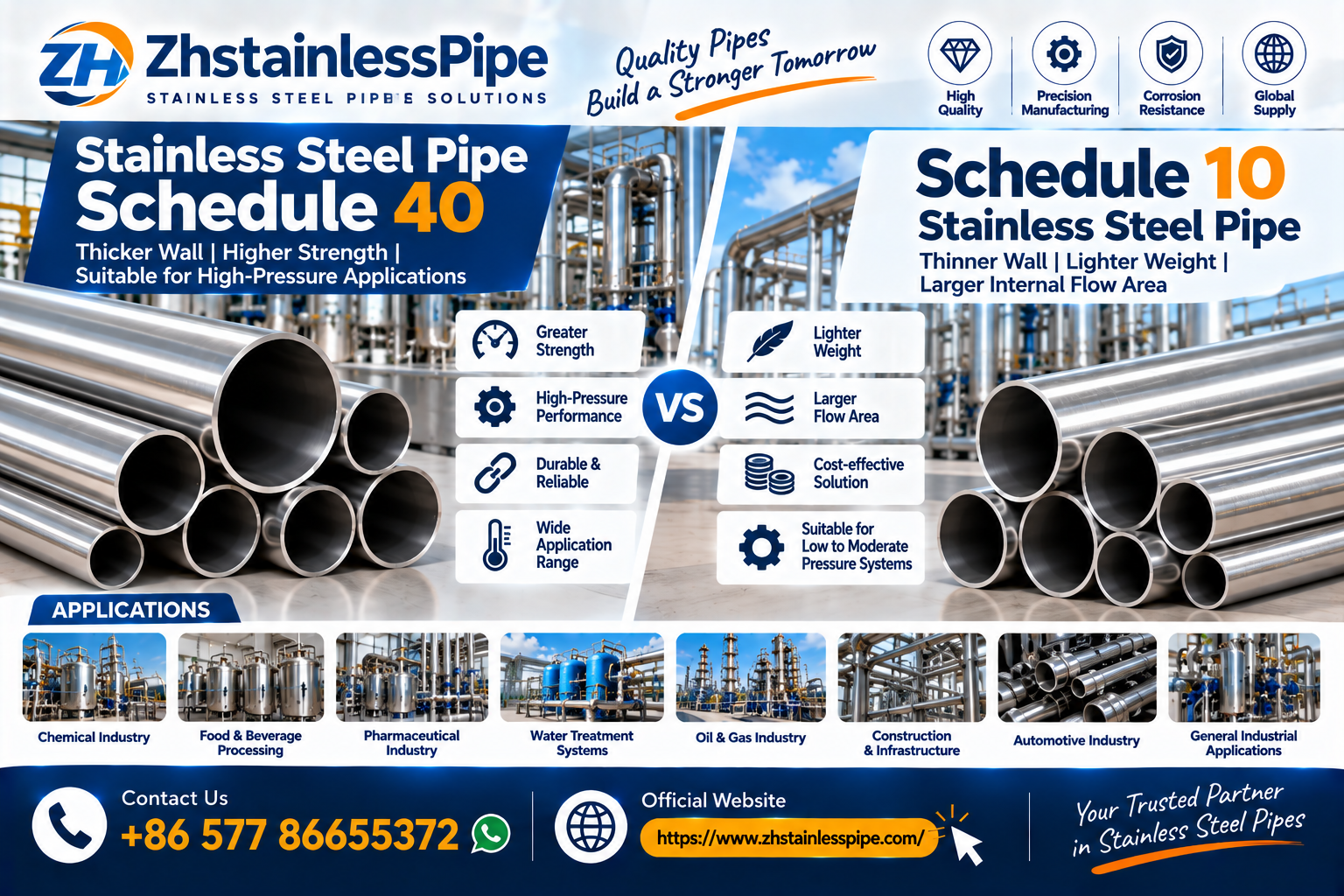
As industrial manufacturers, engineering companies, and infrastructure developers focus on material efficiency, corrosion resistance, and reliable piping performance, choosing the correct stainless steel pipe specification has become an important consideration. Stainless Steel Pipe Schedule 40 is widely used for applications requiring suitable wall thickness and mechanical strength, while Schedule 10 Stainless Steel Pipe offers a thinner-wall alternative for appropriately designed piping systems.
From chemical processing and water treatment to food manufacturing and industrial construction, both pipe schedules serve important engineering requirements.
Understanding their differences can help project engineers, industrial buyers, and procurement professionals make informed decisions about material selection, installation costs, and long-term system performance.
Growing Importance of Stainless Steel Pipe Schedule 40
Stainless Steel Pipe Schedule 40 refers to stainless steel piping manufactured with a specified nominal wall thickness according to applicable dimensional standards.
For stainless steel applications, Schedule 40S is a commonly specified designation under ASME B36.19M. Buyers should distinguish Schedule 40S from Schedule 40 where dimensional differences may apply.
These pipes are considered for applications requiring adequate strength, corrosion resistance, and structural reliability.
Common applications include:
- Chemical Processing: Transporting compatible chemicals and processing fluids.
- Industrial Manufacturing: Supporting fluid distribution and production equipment.
- Water Treatment: Carrying appropriate water and treatment fluids.
- Energy Facilities: Serving suitable utility and industrial piping systems.
- Construction: Providing piping components for engineered installations.
- Food Processing: Supporting processing systems when relevant hygiene requirements are satisfied.
Understanding Schedule 10 Stainless Steel Pipe
Schedule 10 Stainless Steel Pipe is a thinner-wall piping option commonly specified as Schedule 10S for stainless steel applications.
Compared with Schedule 40 or 40S pipes of the same nominal size, Schedule 10S generally offers reduced wall thickness and lower weight per unit length.
Its reduced material requirements may provide practical advantages in suitably engineered applications.
Important characteristics include:
Lightweight Construction: Thinner walls can reduce pipe weight and simplify handling.
Material Efficiency: Reduced material consumption may lower procurement costs.
Corrosion Resistance: Performance depends on the selected stainless steel grade and operating environment.
Installation Flexibility: Lower weight may simplify certain installation activities.
Fluid Transportation: Suitable for compatible piping systems when pressure, temperature, and mechanical requirements are satisfied.
However, thinner-wall piping is not automatically suitable for every low-pressure application. Engineering evaluation remains necessary.
Stainless Steel Pipe Schedule 40 vs Schedule 10: Key Differences
Understanding the differences between pipe schedules is essential when designing industrial piping systems.
| Feature | Schedule 40 / 40S | Schedule 10S |
| Wall thickness | Generally thicker | Generally thinner |
| Pipe weight | Higher for the same nominal size | Lower for the same nominal size |
| Internal diameter | Generally smaller at the same outside diameter | Generally larger |
| Material consumption | Higher | Lower |
| Pressure capability | Potentially greater under comparable conditions | Requires evaluation for intended conditions |
| Common selection focus | Strength and design requirements | Weight and material efficiency |
The actual pressure rating depends on material grade, pipe dimensions, operating temperature, manufacturing method, and applicable design codes.
Neither pipe schedule should be selected based on wall thickness alone.
Stainless Steel Grades Used in Industrial Pipes
Both Stainless Steel Pipe Schedule 40 and Schedule 10 Stainless Steel Pipe may be available in different stainless steel grades.
304 Stainless Steel: A commonly used austenitic grade providing suitable general corrosion resistance and fabrication properties.
316 Stainless Steel: Contains molybdenum and generally offers improved resistance to certain chloride-containing environments.
304L Stainless Steel: A low-carbon grade frequently considered for appropriate welded applications.
316L Stainless Steel: A low-carbon molybdenum-containing grade used in applications requiring suitable corrosion resistance and weldability.
Material selection should consider the transferred fluid, temperature, environmental exposure, and fabrication requirements.
Why Pipe Schedule Matters in Industrial Applications
Pipe schedule influences several aspects of piping system design, including wall thickness, internal flow area, weight, and mechanical performance.
A thicker wall may provide greater pressure resistance under otherwise comparable conditions, but it can also increase material cost and installation weight.
Thinner-wall pipes may offer economic benefits where engineering calculations confirm their suitability.
For example, a Schedule 10 Stainless Steel Pipe may be considered for certain processing or utility lines, while thicker-wall piping may be required where pressure, mechanical loading, or corrosion allowance demands it.
The final decision should follow the applicable engineering design code rather than a general assumption about application type.
Important Standards and Quality Requirements
Industrial buyers should understand the specifications governing stainless steel piping.
Relevant standards may include:
- ASME B36.19M: Covers dimensional requirements for stainless steel pipe schedules.
- ASME B36.10M: Provides dimensions for welded and seamless wrought steel pipe.
- ASTM A312: Covers specified seamless, welded, and heavily cold-worked austenitic stainless steel pipes.
- ASME B31.3: Provides requirements for process piping design in applicable industrial facilities.
These standards address different aspects of piping and should not be treated as interchangeable.
Buyers should request material certificates, dimensional inspection records, and relevant manufacturing documentation.
How to Choose the Right Stainless Steel Pipe
Selecting a suitable pipe requires an engineering-based procurement approach.
Important considerations include operating pressure, design temperature, fluid characteristics, corrosion allowance, pipe diameter, fabrication method, and installation environment.
Businesses should also assess welding requirements, external loading, available fittings, and maintenance expectations.
When comparing Stainless Steel Pipe Schedule 40 with thinner-wall alternatives, procurement teams should consider the total installed cost rather than the pipe purchase price alone.
Professional engineering calculations can help establish whether the proposed specification meets applicable safety and performance requirements.
Frequently Asked Questions (FAQs)
1. What is Stainless Steel Pipe Schedule 40?
It is stainless steel pipe with a specified nominal wall thickness. Schedule 40S is a common stainless steel designation under ASME B36.19M.
2. What is Schedule 10 Stainless Steel Pipe?
It is a thinner-wall stainless steel piping category, commonly designated Schedule 10S, used in appropriately designed industrial systems.
3. What is the main difference between Schedule 10 and Schedule 40?
Schedule 40 or 40S generally has a thicker wall than Schedule 10S at the same nominal pipe size.
4. Is Schedule 40 stronger than Schedule 10?
Under comparable material and dimensional conditions, thicker-wall piping generally provides greater pressure capacity, but actual suitability requires engineering evaluation.
5. Which stainless steel grades are commonly available?
Common options include 304, 304L, 316, and 316L, depending on manufacturing specifications.
6. Is Schedule 10 stainless steel pipe suitable for industrial applications?
Yes. It can be suitable where design calculations and applicable standards confirm adequate performance.
7. Does Schedule 40 pipe cost more than Schedule 10?
Thicker-wall pipe generally requires more material, potentially increasing cost, although actual pricing depends on specifications and market conditions.
8. Can Schedule 10 and Schedule 40 pipes be connected?
They may be connected using appropriately specified fittings and joining procedures, subject to applicable design requirements.
9. How can buyers identify reliable stainless steel pipe suppliers?
Buyers should review manufacturing standards, material certificates, dimensional accuracy, inspection procedures, and technical support.
Media Contact
Department: Stainless Steel Products and Business Communications
Email: sales@zhehengsteel.com
Contact: +86 577 86655372
Official Website: https://www.zhstainlesspipe.com/