
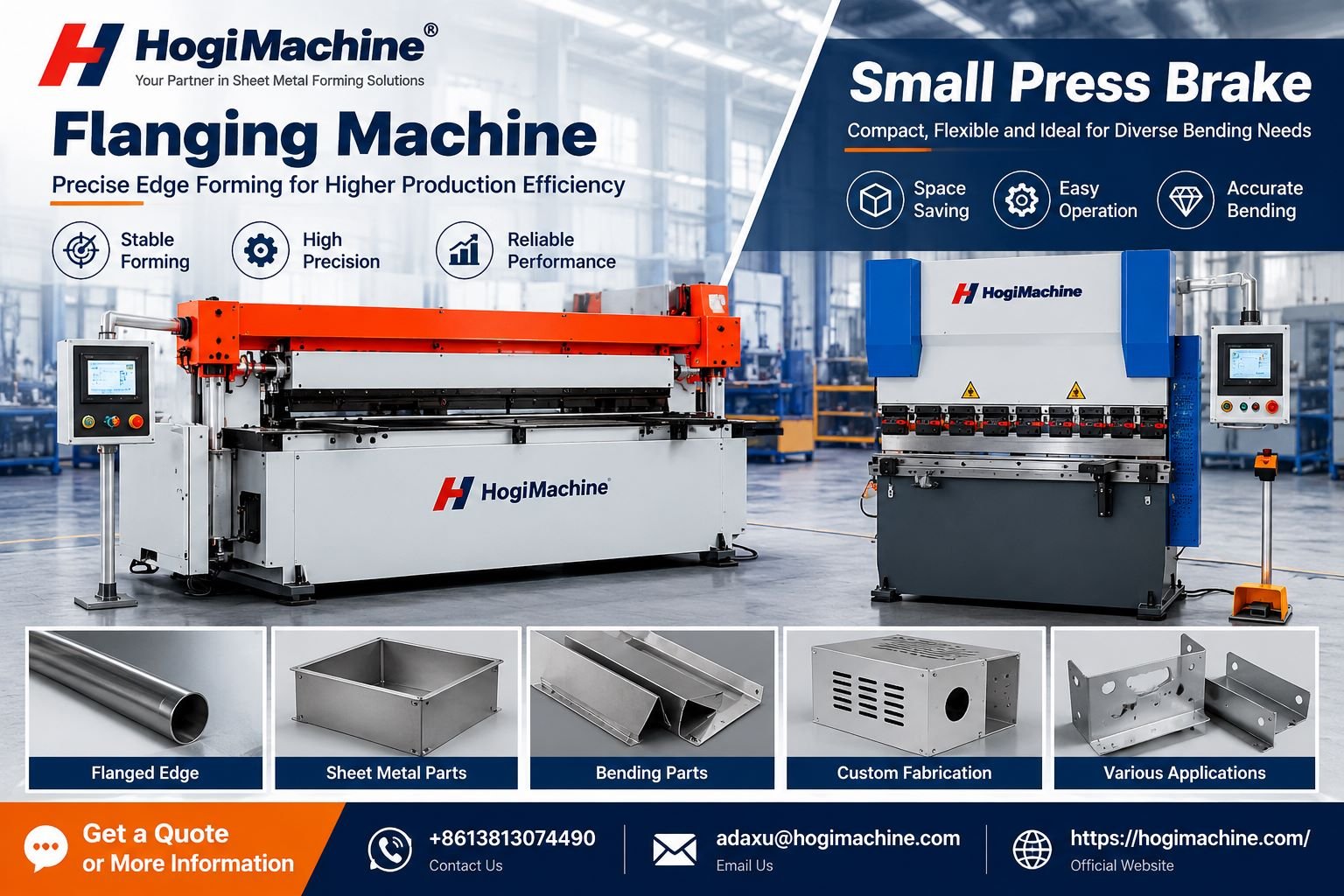
Sheet metal manufacturers are examining how edge design influences product safety, structural performance, and assembly quality. Beyond creating the required shape, fabrication businesses must ensure that finished components are practical to handle, compatible with adjoining parts, and suitable for their intended applications.
A Flanging machine can help manufacturers produce formed edges that support reinforcement, component joining, and specialised structural requirements.
Meanwhile, a small press brake offers controlled bending capabilities for producing brackets, panels, protective covers, and compact metal components.
For manufacturers of industrial enclosures, ventilation equipment, storage systems, and commercial machinery, combining appropriate forming processes can improve component design and manufacturing consistency.
The important consideration is understanding how metal edge geometry contributes to overall product performance.
Why Sheet Metal Edge Design Matters
Sheet metal components often contain exposed edges that require appropriate treatment before installation or use.
Depending on the manufacturing process, cut edges may contain burrs or sharp features that create handling hazards.
Forming operations can help produce useful edge geometries, although separate deburring or finishing may still be necessary.
Properly designed edges can also contribute to component stiffness, alignment, and assembly compatibility.
This approach encourages businesses to evaluate edge requirements during the product design stage.
What Is a Flanging Machine?
A Flanging machine is specialised metal-forming equipment used to bend or shape the edges of compatible metal workpieces.
Depending on its configuration, it can create particular flange profiles on circular, cylindrical, or other suitable components.
Flanging operations may support container manufacturing, ductwork, industrial equipment, and selected metal assemblies.
The correct machine depends on workpiece geometry, material characteristics, and production requirements.
Manufacturers should confirm whether the equipment can accommodate the intended dimensions and forming profile.
Accurate flange formation requires appropriate tooling, machine adjustment, and material preparation.
Understanding a Small Press Brake
A small press brake is compact sheet metal bending equipment that uses suitable tooling to create specified bends.
It can support the manufacture of electrical cabinets, metal brackets, machine covers, and custom fabricated products.
Depending on the model, available features may include adjustable backgauges, programmable controls, and different drive arrangements.
Compact equipment can be useful where workshop space or workpiece dimensions are limited.
However, its forming capability depends on available force, bending length, material thickness, and tooling.
Buyers should evaluate actual technical specifications before selecting a machine.
How Formed Edges Improve Component Strength
Sheet metal can deform under loading when its geometry does not provide sufficient stiffness.
Introducing suitable bends or flanges may increase rigidity in particular directions.
For example, a properly engineered edge flange can contribute to the stiffness of a thin panel.
Similarly, folded edges may form part of a structural or joining arrangement.
However, strengthening effects depend on material thickness, component dimensions, flange geometry, and loading conditions.
Designers should therefore evaluate the complete component before selecting an edge-forming method.
Comparing Edge Forming and General Bending
| Evaluation Factor | Flanging Machine | Small Press Brake |
| Main Operation | Forms suitable workpiece edges | Creates bends along defined lines |
| Typical Geometry | Machine-dependent flange profiles | Straight bends and angular profiles |
| Common Products | Ducts, containers, formed assemblies | Brackets, enclosures, panels |
| Quality Priority | Flange consistency | Bend angle and position |
| Tooling Requirement | Suitable edge-forming arrangement | Compatible punches and dies |
| Design Consideration | Edge profile and material behaviour | Bend radius and material thickness |
Some products may require both forming methods, while others can be manufactured using a single machine.
Why Bend Radius Influences Product Quality
Bend radius is an important factor in sheet metal engineering.
An excessively tight bend can increase localised strain and may contribute to cracking in certain materials.
A larger radius may reduce forming severity but require additional space within the finished component.
The appropriate radius depends on material grade, sheet thickness, grain orientation, and forming method.
For compact enclosures, designers must also consider how bends affect nearby holes, slots, and fastening features.
Careful engineering can reduce manufacturing difficulties and improve assembly fit.
Applications in Industrial Enclosure Manufacturing
Industrial enclosures protect electrical equipment, mechanical assemblies, and other components from appropriate environmental or handling conditions.
Their construction may require accurately bent panels, mounting brackets, doors, and reinforced edges.
A compact press brake can support the production of suitable straight-bent components.
Specialised flanging equipment may be useful where the enclosure or associated assembly requires particular formed edges.
However, enclosure protection depends on more than metal forming.
Seals, fasteners, welding, surface treatments, and complete product design must also be evaluated.
Surface Protection After Metal Forming
Metal-forming operations can influence surface coatings and material appearance.
Certain coated sheets may experience surface damage when bent under unsuitable conditions.
Manufacturers should evaluate coating compatibility, bend radius, and tooling contact surfaces.
For components requiring corrosion resistance, appropriate finishing procedures may be necessary.
Deburring and cleaning can also help prepare metal parts for subsequent coating or assembly processes.
The correct approach depends on the base material and the intended operating environment.
Quality Inspection for Formed Metal Components
Dimensional inspection helps verify whether fabricated components meet approved drawings.
Relevant measurements may include bend angles, flange dimensions, overall geometry, and alignment features.
Manufacturers should also examine visible cracking, unwanted distortion, and surface damage.
For assemblies, checking the fit between adjoining components can reveal problems that individual measurements may not identify.
Consistent inspection procedures help reduce rejected products and assembly difficulties.
Approved samples can provide practical references for repeated manufacturing orders.
Choosing Equipment for Reliable Metal Fabrication
Businesses evaluating forming machinery should consider:
- Component Geometry: Confirm whether the equipment supports the intended shapes.
- Material Compatibility: Review suitable metals and thickness limits.
- Tooling Requirements: Assess available dies and forming accessories.
- Production Accuracy: Verify appropriate forming and positioning capabilities.
- Operator Safety: Evaluate guarding, emergency controls, and training requirements.
- Maintenance Support: Confirm documentation, servicing needs, and replacement-part availability.
Testing representative workpieces before purchasing equipment can help establish practical suitability.
Frequently Asked Questions (FAQs)
1. What is a Flanging machine used for?
A flanging machine forms suitable metal edges to create specified profiles for joining, reinforcement, or other manufacturing purposes.
2. What is a small press brake?
A small press brake is compact machinery used to bend sheet metal into selected angles and shapes using compatible tooling.
3. Can flanging improve sheet metal strength?
Appropriately designed flanges can improve stiffness in certain components, depending on material properties, geometry, and loading conditions.
4. Are press brakes suitable for manufacturing electrical enclosures?
Yes. Suitable press brakes can produce enclosure panels, mounting brackets, and other sheet metal components within their forming capacities.
5. How can manufacturers improve sheet metal forming quality?
Manufacturers should select appropriate tooling, consider bend radius, verify material compatibility, inspect finished components, and maintain safe operating procedures.
Media Contact
Department: Sheet Metal Fabrication and Forming Machinery Enquiries
Contact: +86 138 1307 4490
Email: daxu@hogimachine.com
Official Website: https://hogimachine.com/