
The semiconductor materials industry is placing greater emphasis on reliable deposition equipment as manufacturers and research laboratories develop increasingly sophisticated thin-film structures.
In specialised vacuum deposition systems, the selection of source containers, insulating components, and supporting fixtures can influence process stability, contamination control, and equipment maintenance.
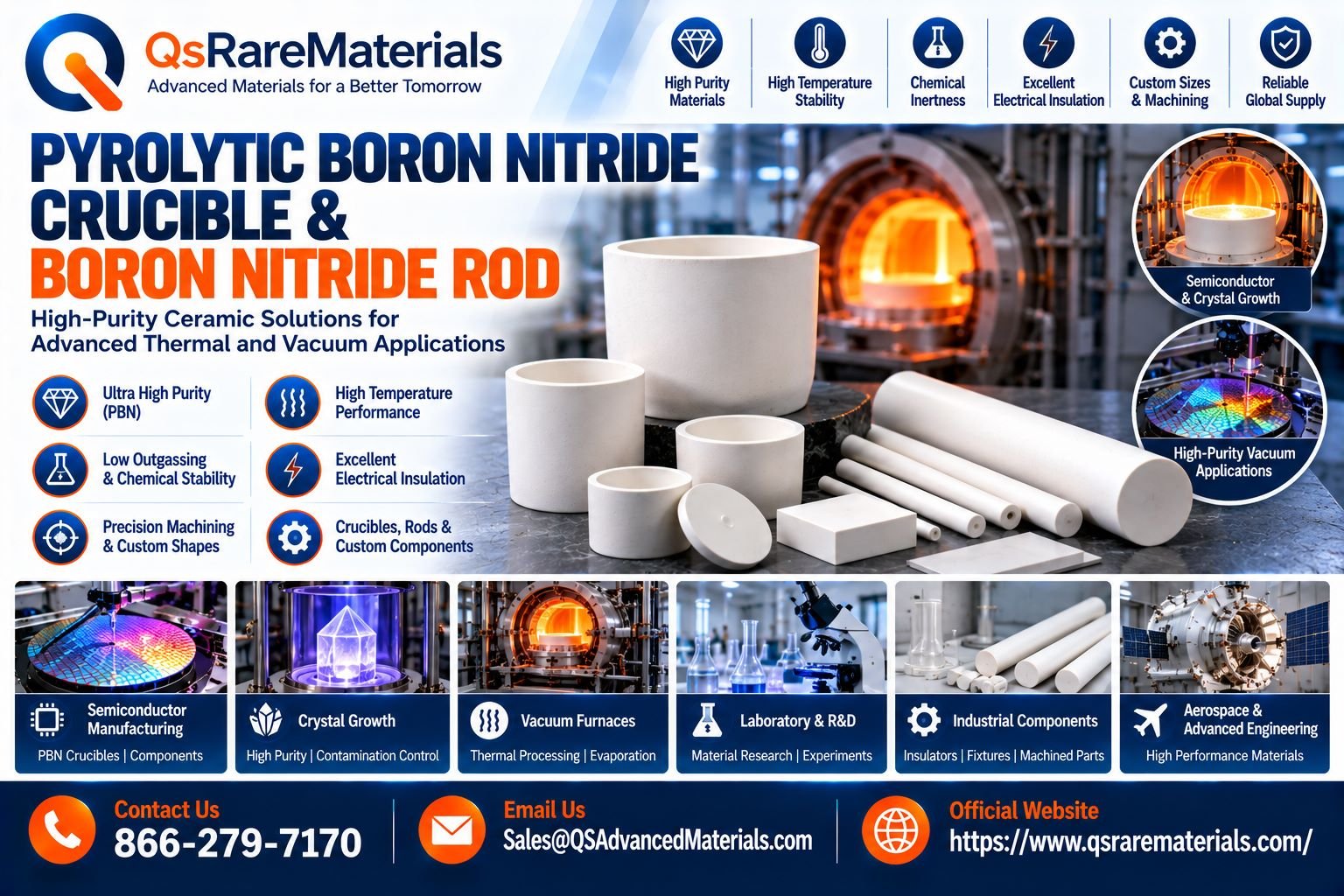
A Pyrolytic Boron Nitride Crucible offers high-purity ceramic containment for compatible materials in selected thermal evaporation and molecular beam epitaxy applications.
Meanwhile, a Boron Nitride Rod provides technical ceramic stock that may be machined into suitable spacers, insulating supports, and specialised equipment components.
Although these materials perform different functions, both can contribute to carefully engineered vacuum processing assemblies.
For semiconductor researchers, materials engineers, and equipment manufacturers, understanding their characteristics can support better component selection and more dependable deposition operations.
Why Thin-Film Deposition Requires Specialised Materials
Thin-film deposition involves forming controlled layers of material on a substrate.
These layers may be used in semiconductor research, optical coatings, electronic devices, and specialised material structures.
Certain deposition methods require source materials to be heated under controlled conditions.
The components surrounding these sources must be compatible with the process environment.
Unwanted reactions, contamination, or mechanical instability can interfere with deposition performance.
This makes source-container engineering an important part of equipment development.
What Is a Pyrolytic Boron Nitride Crucible?
A Pyrolytic Boron Nitride Crucible is a specialised ceramic container made from pyrolytic boron nitride, typically produced through chemical vapour deposition.
PBN is recognised for its high purity, electrical insulation properties, and distinctive thermal characteristics.
Suitable crucibles may be used in selected evaporation sources and molecular beam epitaxy systems.
Their purpose is to contain compatible source materials during controlled heating.
However, suitability depends on the substance being processed, operating temperature, atmosphere, and component geometry.
Chemical compatibility must be verified before approving a crucible for a particular deposition application.
Understanding the Role of a Boron Nitride Rod
A Boron Nitride Rod is a solid technical ceramic component that can be machined into specialised engineering shapes.
Depending on the grade, it may be used to manufacture electrical insulators, spacers, positioning elements, or other suitable fixture components.
Machinable boron nitride can provide flexibility when developing customised laboratory equipment.
However, different boron nitride products may contain different additives and have different mechanical properties.
Hot-pressed boron nitride rods should not automatically be treated as equivalent to high-purity PBN components.
Engineers should evaluate material composition and actual operating requirements before using rods in sensitive equipment.
Why Crucible Purity Matters in Deposition Systems
Thin-film quality can be affected by unwanted material introduced during processing.
Potential contamination sources include source materials, handling tools, processing chambers, and containment vessels.
High-purity ceramic containers may help reduce certain contamination risks when chemically compatible with the source material.
However, high purity does not guarantee that a crucible will remain chemically stable in every application.
Researchers must evaluate potential reactions between the container and its contents.
Appropriate material verification and representative processing trials support reliable equipment design.
How Crucible Geometry Influences Evaporation
Crucible shape can influence the behaviour of source materials during heating.
Important considerations may include internal diameter, depth, wall thickness, and compatibility with the heating assembly.
These characteristics can affect source placement and thermal response.
However, evaporation behaviour also depends on heater construction, material properties, and equipment configuration.
A larger crucible is not automatically more suitable than a smaller one.
Engineers should match container geometry to the intended deposition source and operating conditions.
Comparing Ceramic Components in Vacuum Equipment
| Engineering Factor | Pyrolytic Boron Nitride Crucible | Boron Nitride Rod |
| Main Function | Containment of compatible source materials | Custom fixture and insulating components |
| Typical Structure | High-purity deposited ceramic | Grade-dependent ceramic stock |
| Important Requirement | Chemical and thermal compatibility | Mechanical and electrical suitability |
| Design Priority | Cavity dimensions and wall geometry | Diameter and machined features |
| Main Limitation | Application-dependent chemical behaviour | Brittleness and grade differences |
| Quality Focus | Purity and surface integrity | Dimensions and material consistency |
Both component types require appropriate evaluation before installation.
Thermal Expansion and Mechanical Stability
Vacuum processing assemblies may contain materials with different thermal expansion characteristics.
During heating and cooling, these components can expand or contract at different rates.
Excessive restraint may introduce stress into brittle ceramic parts.
Fixture designers should therefore consider suitable clearances and contact arrangements.
PBN also has anisotropic properties, meaning certain thermal characteristics vary with material orientation.
This behaviour can influence engineering decisions in specialised heating assemblies.
Appropriate testing helps determine whether a proposed configuration is mechanically suitable.
Improving Equipment Maintenance Through Component Design
Deposition equipment requires periodic inspection and servicing according to its design and operating requirements.
Ceramic components may need replacement if they become damaged or unsuitable for continued use.
Clear component specifications can simplify purchasing and maintenance planning.
Customised rod-based insulators or spacers should be designed for safe installation and removal.
Crucible replacement procedures should also minimise unnecessary mechanical loading.
Careful component design can improve serviceability without compromising equipment performance.
Managing Component Handling and Cleanliness
Ceramic handling procedures are particularly important in high-purity research environments.
Crucibles should be examined for chips, cracks, contamination, and other visible defects.
Machined ceramic supports should also be checked before installation.
Suitable handling tools and clean storage conditions may help reduce unwanted contamination.
Cleaning procedures must be compatible with the ceramic grade and intended application.
Aggressive cleaning techniques can damage delicate surfaces.
Laboratories should document appropriate inspection and handling practices.
Quality Requirements for Custom Ceramic Procurement
Specialised equipment manufacturers may require nonstandard crucible sizes or machined ceramic components.
Before ordering, buyers should establish relevant engineering specifications.
Important considerations include:
- Material Grade: Confirm purity and composition.
- Component Geometry: Specify dimensions and practical tolerances.
- Operating Conditions: Identify temperature and atmosphere.
- Chemical Compatibility: Evaluate relevant source materials.
- Mechanical Requirements: Review loading and support arrangements.
- Inspection Documentation: Establish appropriate acceptance criteria.
Clear technical communication helps suppliers understand the intended component function.
Frequently Asked Questions (FAQs)
1. What is a Pyrolytic Boron Nitride Crucible?
It is a high-purity ceramic container produced from pyrolytic boron nitride for selected specialised thermal processing and deposition applications.
2. What is a Boron Nitride Rod used for?
It may be machined into electrical insulators, ceramic spacers, supporting fixtures, and other technical components.
3. Are PBN crucibles suitable for molecular beam epitaxy?
Certain PBN crucibles are suitable for selected molecular beam epitaxy applications, depending on source material compatibility and equipment requirements.
4. Can boron nitride rods operate in vacuum equipment?
Suitable grades may be used in selected vacuum applications, provided their thermal, chemical, and mechanical properties meet the requirements.
5. How should manufacturers select ceramic deposition components?
They should evaluate material purity, component geometry, thermal behaviour, chemical compatibility, operating atmosphere, and quality documentation.
Media Contact
Department: Advanced Ceramic Materials and Semiconductor Equipment Enquiries
Phone: 866-279-7170
Email: Sales@QSAdvancedMaterials.com
Official Website: https://www.qsrarematerials.com/