
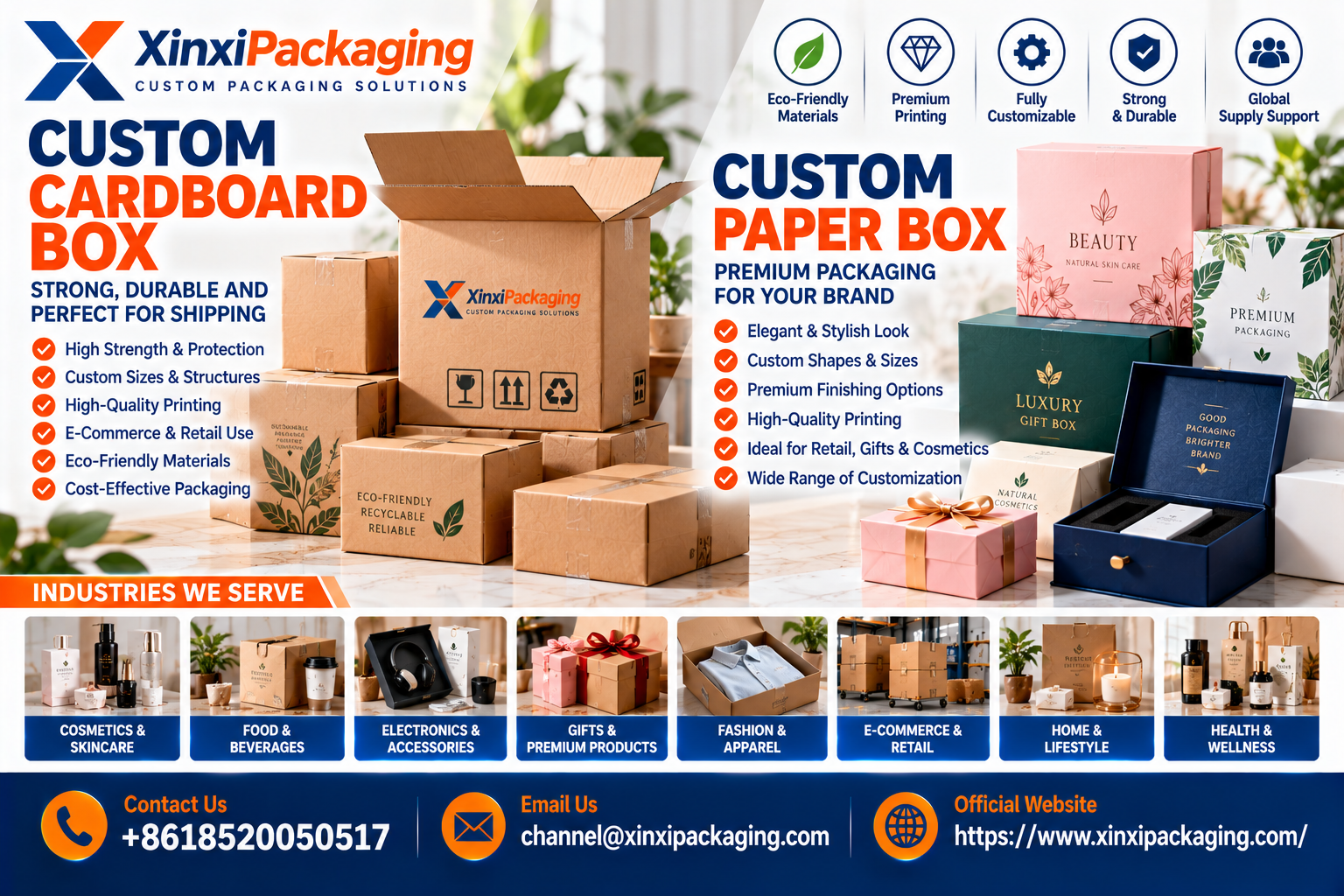
Packaging development is becoming an important business consideration for manufacturers, retailers, and emerging consumer brands. As companies introduce new products and expand their collections, packaging must support efficient production, consistent presentation, and practical inventory management.
A Custom Cardboard Box allows businesses to develop packaging structures according to specific product dimensions, protective requirements, and branding objectives.
Meanwhile, a Custom Paper Box offers flexible presentation possibilities for cosmetics, electronics, gifts, accessories, and other suitable retail products.
Although these packaging categories can overlap, their construction, material specifications, and intended applications may differ.
For businesses managing multiple product lines, the challenge is no longer limited to creating attractive packaging. It involves developing packaging systems that can adapt to product launches, changing customer requirements, and commercial growth.
Why Growing Brands Need Flexible Packaging Strategies
Businesses frequently introduce products in different sizes, colours, and configurations.
Creating completely separate packaging for every variation may increase design complexity, inventory requirements, and production expenses.
A flexible packaging strategy allows brands to standardise selected structural components while adapting artwork and internal arrangements.
For example, a personal care company may use a consistent carton style across several products while adjusting dimensions and printed information.
This approach helps businesses connect packaging development with broader operational planning.
What Is a Custom Cardboard Box?
A Custom Cardboard Box is a packaging container developed using suitable cardboard, paperboard, or corrugated materials according to the intended product requirements.
The term cardboard is used broadly in commercial packaging, so buyers should clarify the actual material specification.
Depending on construction, cardboard boxes may serve shipping, storage, retail display, or protective packaging purposes.
Customisation can include structural dimensions, board strength, printing, internal partitions, and closure mechanisms.
A suitable design should account for product weight, fragility, handling conditions, and expected distribution requirements.
The most appropriate material is determined by function rather than appearance alone.
Understanding Custom Paper Box Applications
A Custom Paper Box commonly refers to packaging constructed from paper-based board materials and customised for specific product presentation requirements.
Suitable designs may include folding cartons, decorative retail boxes, sleeves, and selected gift packaging structures.
Brands can develop paper boxes with distinctive printing, textures, and structural styles.
For example, a skincare product may require a compact folding carton, while a premium accessory collection may benefit from a stronger presentation box.
However, paper-based construction does not automatically guarantee sufficient protection.
Packaging manufacturers should evaluate board properties, structural performance, and product compatibility before approving a design.
Packaging Standardisation Without Losing Brand Identity
Standardisation helps businesses manage packaging across multiple product categories.
A company can establish common visual elements such as typography, colours, logo placement, and finishing requirements.
Individual products can then use appropriately adjusted structures.
This reduces unnecessary design variation while maintaining recognizable branding.
Standardised packaging specifications may also improve coordination between purchasing departments and manufacturers.
However, businesses should avoid forcing products into unsuitable box dimensions.
The objective is to balance design consistency with functional requirements.
Why Packaging Prototypes Are Essential
Packaging development should include practical evaluation before commercial production.
Digital artwork demonstrates appearance but cannot fully establish how a box performs during handling.
Physical prototypes allow teams to examine dimensions, folding behaviour, closures, and product placement.
For protective applications, suitable testing can help assess resistance to compression, impacts, and distribution-related stresses.
Retail cartons may require additional evaluation of printing quality and product accessibility.
Approved samples can also serve as references for subsequent manufacturing orders.
Comparing Cardboard and Paper Packaging Options
| Evaluation Factor | Custom Cardboard Box | Custom Paper Box |
| Material Options | Corrugated board and other suitable board materials | Folding carton board and other paperboard materials |
| Common Applications | Shipping, storage, and retail products | Retail display, gifts, and product cartons |
| Main Priority | Structural suitability and protection | Product presentation and functional design |
| Customisation | Dimensions, board grades, printing | Artwork, structure, finishes |
| Strength Requirements | Based on product and distribution conditions | Based on board grade and construction |
| Manufacturing Focus | Accurate conversion and assembly | Precise cutting, folding, and printing |
The categories are not mutually exclusive. Both require accurate specifications and appropriate manufacturing quality.
Managing Packaging Inventory During Product Launches
Introducing a new product involves coordination between packaging design, manufacturing, procurement, and distribution.
Packaging delays can affect product availability even when the merchandise itself is ready.
Businesses should confirm box specifications before placing production orders.
Packaging inventory should also reflect realistic product demand and storage capacity.
Ordering excessive quantities can create unnecessary stock, particularly when artwork or product information changes.
Conversely, insufficient packaging inventory may interrupt packing operations.
Clear communication between purchasing teams and packaging suppliers supports more effective production planning.
How Printing Accuracy Influences Product Presentation
Custom packaging is frequently used to communicate product information and brand identity.
Printing errors may affect customer confidence or create regulatory concerns where required information is involved.
Important considerations include colour consistency, readable text, barcode placement, and correct product descriptions.
Brands should maintain approved artwork versions and establish procedures for communicating changes.
Different printing surfaces can also influence colour reproduction.
Physical samples are useful when confirming decorative finishes and visual consistency.
Accurate artwork management helps prevent avoidable production errors and unnecessary material waste.
Environmental Considerations in Custom Box Design
Businesses are examining packaging options that reduce unnecessary material consumption while maintaining suitable product protection.
Paperboard packaging may offer recycling opportunities where materials and local collection systems permit.
However, coatings, laminations, adhesives, and mixed-material components can influence recyclability.
An oversized box can also increase packaging material consumption and shipping volume.
Manufacturers should evaluate dimensions, construction, and material efficiency together.
Environmental claims should reflect verifiable information rather than relying on general descriptions such as green or sustainable.
How to Choose a Reliable Custom Packaging Manufacturer
Businesses evaluating packaging suppliers should consider technical capabilities and commercial reliability.
Important factors include:
- Material Specifications: Confirm appropriate board types and structural properties.
- Customisation: Evaluate available box styles, dimensions, and printing options.
- Prototype Development: Review physical samples before production.
- Quality Control: Establish dimensional and visual acceptance requirements.
- Production Planning: Coordinate order quantities and delivery arrangements.
- Communication: Ensure artwork revisions and technical requirements are clearly documented.
A suitable packaging partner should support practical product requirements alongside professional presentation.
Frequently Asked Questions (FAQs)
1. What is a Custom Cardboard Box?
A custom cardboard box is a packaging container manufactured with selected dimensions, materials, structures, and branding features according to product requirements.
2. What is a Custom Paper Box?
A custom paper box is a paper-based packaging structure developed for suitable retail, gift, product presentation, or protective applications.
3. Can cardboard boxes be customised for different industries?
Yes. Suitable designs can be developed for cosmetics, electronics, apparel, accessories, household goods, and other commercial products.
4. Are custom paper boxes recyclable?
Many paperboard boxes can be recyclable, but actual suitability depends on their materials, coatings, construction, and local recycling facilities.
5. How can businesses choose the right custom packaging?
Businesses should consider product dimensions, handling requirements, structural strength, printing quality, material efficiency, and manufacturing consistency.
Media Contact
Department: Custom Cardboard and Paper Packaging Enquiries
Contact: +86 185 2005 0517
Email: channel@xinxipackaging.com
Official Website: https://www.xinxipackaging.com/
Read More:-