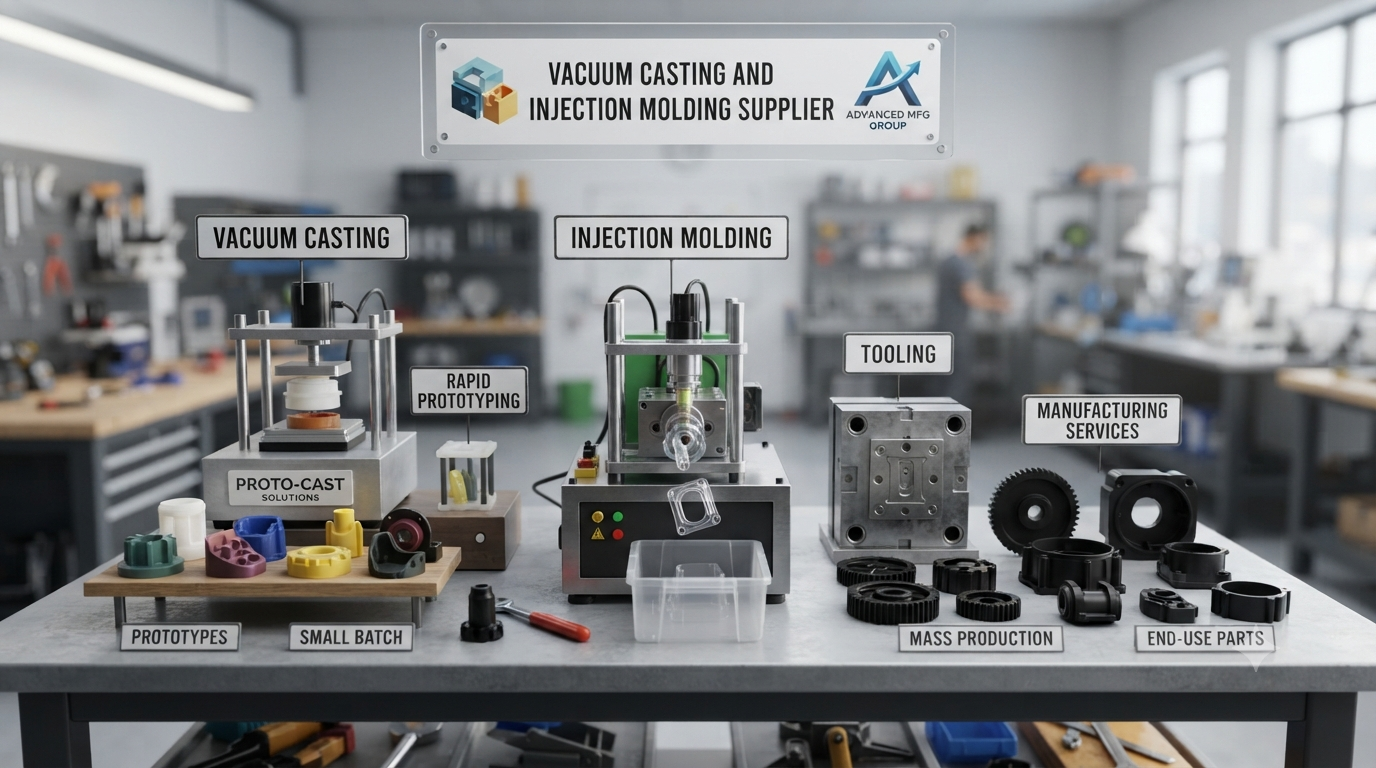
Manufacturers and product development teams are increasingly focused on shortening the journey between initial design and commercial production without compromising product validation. Within this changing manufacturing environment, vacuum casting is playing an important role in prototype and low-volume production, while demand for an experienced injection molding supplier remains closely linked to scalable manufacturing.
The combination reflects a broader shift in product development: companies want to test physical products earlier, identify design problems before permanent tooling and create a smoother transition into volume production.
Rather than committing immediately to expensive production moulds, development teams can use flexible prototype manufacturing methods to evaluate components before final tooling decisions are made.
Vacuum Casting Strengthens the Prototype-to-Production Process
Vacuum casting has become a practical manufacturing option when companies require multiple realistic prototypes but are not yet ready for production tooling.
The process typically starts with a master model manufactured through CNC machining or high-resolution 3D printing. A silicone mould is produced around this master, creating a detailed cavity after the original pattern is removed.
Polyurethane resin is then introduced into the mould under vacuum conditions. The controlled environment helps minimise trapped air and allows the casting material to reproduce detailed features.
After curing, components can undergo trimming and finishing operations such as painting, polishing, texturing or printing.
For manufacturers, the key advantage is flexibility. Small batches can be produced for testing and evaluation before substantial investment is made in injection mould tooling.
Demand for Production-Like Prototypes Continues to Expand
Modern development programmes frequently require more than one prototype.
Engineering teams may need multiple components for:
- Assembly testing
- Functional evaluation
- Customer demonstrations
- Field trials
- Product photography
- Trade exhibitions
- Internal design approval
- Packaging development
- Limited market testing
This requirement creates a manufacturing space between individual 3D-printed prototypes and full-scale injection moulding.
Vacuum casting can help fill that space by producing small batches with consistent appearance and detailed surface reproduction.
For businesses introducing completely new products, this additional validation stage can provide valuable information before the design becomes locked into permanent tooling.
Injection Molding Suppliers Face Growing Engineering Expectations
As product development becomes more sophisticated, businesses are expecting more from an injection molding supplier than simply manufacturing plastic components.
Customers increasingly need engineering support before tooling begins.
An experienced supplier may contribute to:
- Design for Manufacturing reviews
- Material selection
- Tool engineering
- Mould-flow considerations
- Prototype development
- Injection mould production
- Dimensional inspection
- Surface finishing
- Assembly
- Production quality control
This expanded role means supplier selection can influence a project long before the first production component leaves the moulding machine.
Manufacturers Focus More Closely on DFM
Design for Manufacturing, commonly known as DFM, is becoming an important link between product design and commercial manufacturing.
A CAD model can be technically complete while still containing features that create difficulties during injection moulding.
An injection molding supplier may review the design for wall thickness, draft, undercuts, ribs, bosses, gate locations, parting lines and ejection requirements.
Wall Thickness Remains a Key Design Consideration
Uneven wall sections can influence material flow and cooling. Designers therefore need to consider whether thickness changes are necessary and whether geometry can be optimised.
Draft Angles Support Reliable Part Release
Moulded components need to separate from tooling after cooling. Appropriate draft can make ejection easier and reduce manufacturing difficulties.
Undercuts Can Increase Tool Complexity
An undercut may require sliders, lifters or other mechanisms inside the mould.
These features are sometimes essential, but identifying unnecessary undercuts during DFM can potentially simplify tooling.
Ribs and Bosses Require Careful Engineering
Ribs provide structural reinforcement, while bosses are frequently used for screws, inserts and assembly points.
Their proportions and locations need careful consideration to balance mechanical performance with manufacturability.
Vacuum Casting and Injection Moulding Serve Different Production Needs
Despite producing visually similar components in some applications, vacuum casting and injection moulding have fundamentally different production characteristics.
| Manufacturing Area | Vacuum Casting | Injection Moulding |
| Main application | Prototype and low-volume production | Repeatable volume production |
| Mould material | Silicone | Aluminium or steel |
| Initial tooling requirement | Lower | Higher |
| Tool lifespan | Limited | Long |
| Design flexibility | High | Reduced after tooling |
| Material range | Casting resins | Wide thermoplastic range |
| Typical production scale | Small batches | Medium to very large quantities |
| Automation | Limited | High |
| Repeatability | Good | Very high |
| Best stage | Development and validation | Commercial manufacturing |
Manufacturing experts therefore generally assess expected quantity alongside product maturity when selecting a process.
Prototype Validation Can Reduce Late Design Changes
One reason businesses use vacuum casting before injection moulding is the cost difference between changing a digital design and modifying completed tooling.
Consider a manufacturer developing an industrial handheld controller.
After producing several early prototypes, the company believes the design is ready. Instead of immediately manufacturing production tooling, it produces 40 cast units for controlled customer evaluation.
Testing reveals that users want easier access to a connector located on the side of the housing.
Engineers modify the CAD design before the injection mould is manufactured.
Had the problem been identified only after tooling, the company might have required additional mould modification.
This illustrates why prototype manufacturing is increasingly treated as a risk-management tool rather than simply a way to create presentation samples.
Material Selection Becomes More Application-Specific
Another important trend is the growing emphasis on selecting materials according to operating conditions.
An injection molding supplier may process numerous thermoplastics, including:
- ABS
- Polypropylene
- Polyethylene
- Polycarbonate
- Nylon
- POM
- PMMA
- TPE
- TPU
- Reinforced engineering plastics
The correct material depends on more than cost.
Designers may need to consider temperature, impact resistance, chemicals, UV exposure, moisture, friction, dimensional stability and appearance.
For vacuum casting, polyurethane systems can provide different visual and mechanical characteristics for prototype evaluation. However, engineers should understand that casting materials do not necessarily reproduce every property of the final production thermoplastic.
Automotive and Electronics Industries Remain Important Users
The ability to create physical parts before production makes vacuum casting relevant across numerous industries.
Automotive development teams can use cast prototypes for interior components, housings, controls and design evaluation.
Consumer electronics companies may require prototype enclosures for assembly testing, photography or customer demonstrations.
Industrial equipment manufacturers can evaluate protective covers, control housings and specialised components.
Other potential application areas include:
- Consumer products
- Medical equipment development
- Robotics
- Telecommunications
- Smart devices
- Household appliances
- Industrial automation
Final manufacturing requirements vary considerably by industry, particularly where regulatory or safety standards apply.
Supplier Selection Moves Beyond Price Comparison
Procurement teams traditionally place significant emphasis on mould price and unit cost. While both remain important, technical capability is becoming equally relevant.
Businesses evaluating an injection molding supplier should consider:
- Engineering experience
- DFM support
- Tool manufacturing capability
- Material expertise
- Production equipment
- Inspection facilities
- Quality management
- Prototype capabilities
- Secondary finishing
- Assembly support
- Communication
- Production capacity
A low initial quotation may offer limited value if significant tooling modifications are required later.
Integrated Manufacturing Services Can Simplify Product Launches
Another development within the industry is the growing preference for suppliers capable of supporting multiple stages of manufacturing.
A project might progress through:
CAD Design → 3D Prototype → Vacuum Casting → Testing → DFM → Tooling → Injection Moulding → Assembly
When these stages are coordinated effectively, information gathered during prototype development can support later tooling decisions.
For companies managing complex supply chains, using one manufacturing partner for multiple stages may also reduce communication gaps between prototype and production teams.
What Companies Should Prepare Before Requesting a Quote
Manufacturers can receive more accurate technical feedback by providing detailed project information from the beginning.
Useful information includes:
- 3D CAD files
- Engineering drawings
- Prototype quantity
- Expected production volume
- Material requirements
- Critical dimensions
- Dimensional tolerances
- Colour requirements
- Surface finish
- Application environment
- Assembly requirements
- Production schedule
Providing projected future quantities is particularly helpful because the injection molding supplier can assess whether prototype casting, rapid tooling or full production tooling is more appropriate.
Frequently Asked Questions
1. Why is vacuum casting receiving attention in product development?
Vacuum casting enables businesses to manufacture small batches of realistic components before investing in permanent production tooling.
2. How does vacuum casting work?
A silicone mould is created from a master model, after which polyurethane resin is cast into the mould under vacuum conditions.
3. Is vacuum casting suitable for high-volume manufacturing?
Generally, it is better suited to prototypes and low-volume requirements because silicone moulds have limited production life.
4. Why use vacuum casting before injection moulding?
It allows teams to evaluate physical products and identify potential design changes before committing to metal tooling.
5. What does an injection molding supplier provide?
An injection molding supplier may provide DFM, tooling, material processing, production, inspection, finishing and assembly services.
6. What is DFM?
Design for Manufacturing evaluates product geometry to identify features that could affect mould construction, manufacturing efficiency or component quality.
7. Which materials are commonly injection moulded?
ABS, PP, PE, PC, nylon, POM, PMMA, TPE and TPU are among the commonly processed thermoplastics.
8. Can vacuum casting produce finished-looking samples?
Yes. Cast components can often be painted, polished, textured or otherwise finished to achieve a professional appearance.
9. Is injection moulding suitable for small quantities?
It can be, but tooling economics need to be considered. Prototype tooling or alternative processes may sometimes be more appropriate.
10. How should companies select an injection molding supplier?
Companies should assess engineering capability, tooling experience, quality systems, material knowledge, capacity, communication and total project cost.
https://newsgrow.blogspot.com/2026/08/rapid-injection-molding-and-china-rapid.html
https://newsgrow.blogspot.com/2026/08/aluminum-prototype-and-sheet-metal.html
https://newsgrow.blogspot.com/2026/08/deep-information-about-sheet-metal.html
https://newsgrow.blogspot.com/2026/08/vacuum-casting-and-injection-molding.html