When manufacturers plan a plastic processing line, one important decision is choosing the right extrusion technology. The twin extruder and single extruder are widely used across plastic, polymer, recycling, masterbatch, pipe, profile, sheet, and compounding industries. However, they are designed to solve different processing challenges.
A single extruder offers simplicity, stable production, and economical operation, while a twin extruder provides advanced mixing and greater flexibility for complicated formulations.
So, which technology is right for your application? This guide explores how both systems work, where they perform best, and what manufacturers should consider before investing.
What Exactly Happens During Extrusion?
Extrusion converts raw material into a continuous product or processed compound.
Plastic pellets, powders, recycled material, or other ingredients enter the extruder through a feeding system. Rotating screws move the material through a temperature-controlled barrel.
During this journey, several processes may occur:
- Material transportation
- Compression
- Heating and melting
- Mixing
- Homogenization
- Degassing
- Pressure development
Finally, the processed material passes through a die or downstream system.
The screw configuration has a major influence on how effectively these operations occur.
What Is a Single Extruder?
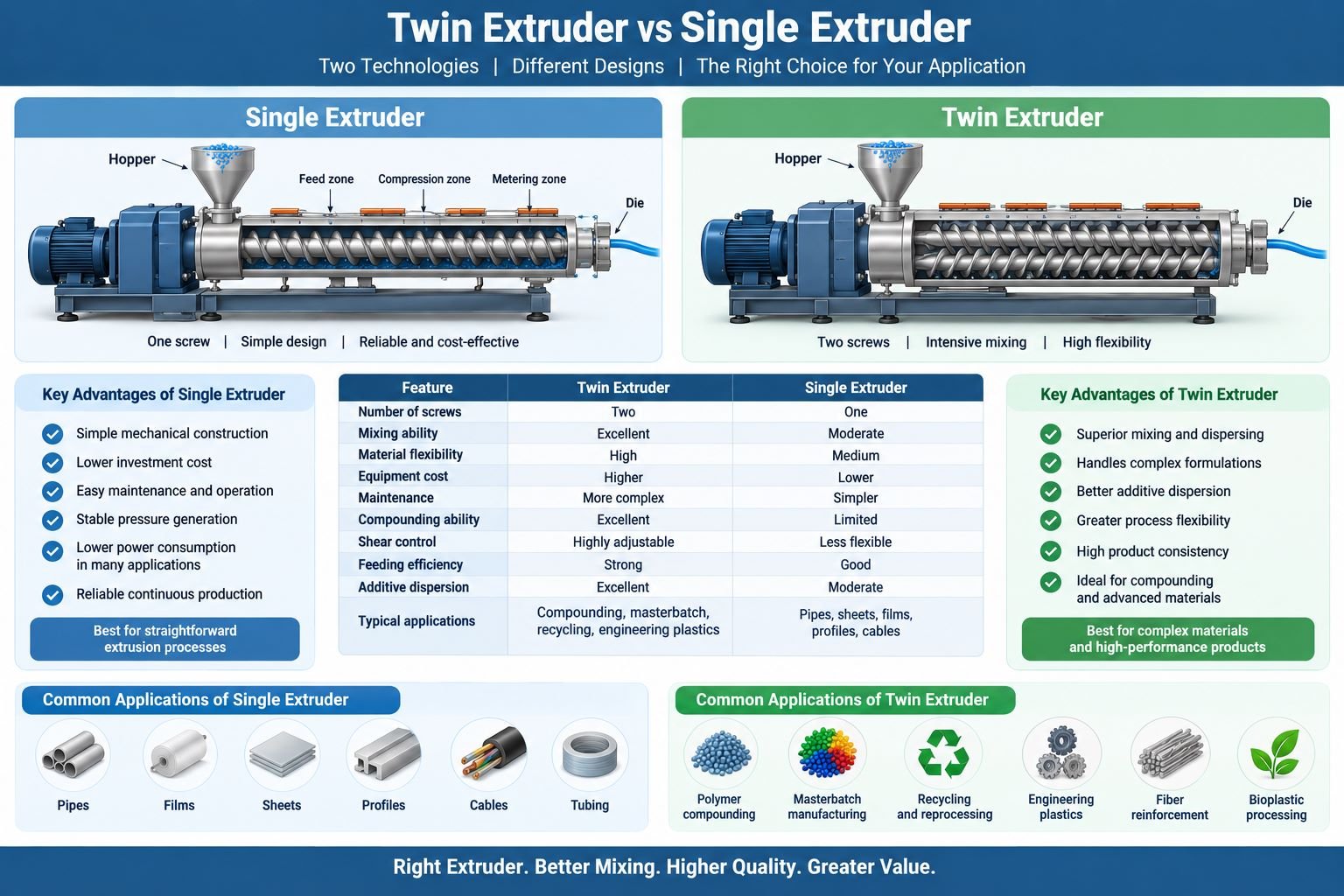
A single extruder contains one rotating screw inside a heated barrel. It is one of the most established extrusion technologies and remains widely used because of its straightforward operation.
The screw generally includes feeding, compression, and metering sections.
Material enters through the feed zone and moves toward the compression section. Heat and mechanical energy gradually melt the polymer. The metering section then helps stabilize the melt before it reaches the die.
Why Is Single Extrusion Still So Popular?
The biggest advantage of a single extruder is not technological complexity but practical efficiency.
For standardized extrusion operations, manufacturers often do not need intensive mixing. They need reliable material transportation, uniform melting, stable pressure, and continuous output.
Key advantages include:
- Simple machine construction
- Lower initial investment
- Straightforward operation
- Easier maintenance
- Stable melt pressure
- Reliable continuous production
- Good efficiency with standard polymers
This makes single-screw technology highly attractive for high-volume manufacturing.
Where Is a Single Extruder Commonly Used?
A single extruder is generally preferred when the raw material has already been compounded and primarily needs melting and shaping.
Common applications include:
- Plastic pipe manufacturing
- Blown film production
- Cast film processing
- Plastic sheet extrusion
- Profile manufacturing
- Wire and cable coating
- Plastic tubing
- Extrusion coating
For these applications, adding additional processing complexity may not necessarily deliver significant benefits.
What Is a Twin Extruder?
A twin extruder uses two screws operating within the same barrel. The screws interact with the material and, depending on the design, with each other.
This configuration creates stronger conveying and mixing characteristics.
Twin-screw machines are particularly valuable when manufacturers need to combine polymers with pigments, fillers, fibers, stabilizers, modifiers, or other ingredients.
Instead of simply melting material, the machine can effectively become a continuous processing system.
Why Does a Twin Extruder Provide Better Mixing?
Imagine adding a concentrated pigment to a polymer. Simply melting both ingredients together does not guarantee uniform color.
The pigment must be distributed throughout the entire polymer matrix.
A twin extruder repeatedly divides, stretches, redistributes, and recombines the material as it moves through the barrel.
Two important forms of mixing can occur.
Distributive Mixing
Distributive mixing spreads components throughout the formulation.
Its purpose is to achieve uniform ingredient distribution without necessarily breaking individual particles apart.
Dispersive Mixing
Dispersive mixing applies mechanical stress to particle clusters or agglomerates.
This becomes important when processing:
- Pigments
- Calcium carbonate
- Talc
- Flame retardants
- Reinforcing materials
- Specialty additives
Proper dispersion can directly influence the appearance, strength, consistency, and processing behavior of the final compound.
Twin Extruder vs Single Extruder: Quick Comparison
| Feature | Twin Extruder | Single Extruder |
| Number of screws | Two | One |
| Mixing capability | Excellent | Moderate |
| Machine complexity | Higher | Lower |
| Initial investment | Generally higher | Generally lower |
| Compounding | Excellent | Limited |
| Standard extrusion | Good | Excellent |
| Additive dispersion | High | Moderate |
| Material flexibility | High | Good |
| Maintenance | More specialized | Simpler |
| Process customization | Extensive | Moderate |
Neither machine should be selected simply because it appears more advanced. Production requirements should determine the choice.
Why Is Twin Extrusion Important for Compounding?
Compounding involves modifying a polymer to achieve specific properties.
For example, manufacturers might add glass fiber to improve mechanical strength or calcium carbonate to modify stiffness and processing economics.
A typical formulation could contain:
- Base polymer
- Mineral fillers
- Pigments
- Stabilizers
- Lubricants
- Impact modifiers
- Reinforcing fibers
- Flame retardants
A twin extruder can provide the intensive mixing required to distribute these components consistently.
This explains why twin-screw extrusion is widely used for engineering compounds, masterbatch, filled polymers, reinforced materials, and specialty formulations.
What Role Does Screw Design Play?
Screw design is one of the most important factors affecting extrusion performance.
The single extruder normally uses a continuous screw geometry designed to transport, compress, melt, and meter the polymer.
Twin-screw machines can offer more configurable processing sections.
Depending on the application, screw elements can include:
- Conveying sections
- Kneading blocks
- Mixing elements
- Reverse elements
- High-shear sections
Engineers can arrange these elements to influence mixing intensity, residence time, pressure, and material transportation.
How Does Twin Extrusion Handle Different Ingredients?
Modern polymer formulations can contain ingredients with very different characteristics.
Some may be pellets, others powders, fibers, or liquids.
A twin extruder can support multiple feeding locations. The base resin may enter through the main feeder while fillers or fibers can be introduced through side feeding systems.
Liquid additives can also be introduced at selected processing points.
This provides manufacturers with greater control over when ingredients encounter heat and mechanical shear.
Can Extruders Process Recycled Plastic?
Yes. Extrusion technology plays an important role in plastic recycling.
However, recycled materials can create unique processing challenges compared with virgin polymers.
Recycled feedstock may contain:
- Moisture
- Printing residues
- Volatile substances
- Different polymer grades
- Inconsistent particle sizes
- Contaminants
Both the single extruder and twin-screw systems can process suitable recycled plastics, depending on material condition and production objectives.
When extensive homogenization, blending, or devolatilization is required, twin-screw technology can provide additional processing flexibility.
Why Is Degassing Important?
Moisture, air, and volatile compounds trapped inside molten polymers can contribute to surface defects, bubbles, odor, and inconsistent product properties.
Extrusion systems can therefore include venting and vacuum degassing zones.
A properly configured twin extruder can provide dedicated sections for removing unwanted volatile substances while maintaining continuous processing.
This feature is particularly useful in recycling and specialized compounding applications.
Which Extruder Offers Better Energy Efficiency?
There is no universal answer because energy consumption depends on machine size, output, screw configuration, polymer type, temperature, and processing conditions.
A single extruder may provide excellent energy efficiency for straightforward production because of its simpler mechanical configuration.
A twin-screw system can require greater installed power but may perform several manufacturing operations simultaneously.
Therefore, manufacturers should consider energy consumption per kilogram of acceptable finished material rather than comparing motor ratings alone.
How Should You Choose the Right Extruder?
Before choosing extrusion equipment, consider these questions:
- What polymer will you process?
- Does the formulation contain fillers?
- Is intensive mixing necessary?
- Are reinforcing fibers involved?
- Is degassing required?
- What output capacity is needed?
- How frequently will formulations change?
- What product quality is expected?
- What maintenance resources are available?
- What is the target production cost?
If your material is already compounded and primarily requires melting and shaping, a single extruder may be the better option.
If your process requires mixing, modification, filler incorporation, or advanced compounding, a twin extruder may offer greater flexibility.
Frequently Asked Questions
What is the basic difference between twin and single extruders?
A twin extruder uses two screws, while a single extruder processes material using one rotating screw.
Which extruder is better for mixing?
Twin-screw extrusion generally offers stronger distributive and dispersive mixing.
Is a single extruder suitable for pipes?
Yes. Single-screw machines are extensively used for PE and PP pipe production.
Which machine is suitable for masterbatch?
A twin extruder is generally preferred because masterbatch requires effective pigment or additive dispersion.
Are twin extruders suitable for recycling?
Yes. They can be configured for recycling applications requiring blending, homogenization, filtration, or devolatilization.
Which extruder costs less?
A single extruder usually requires a lower initial investment because of its simpler mechanical construction.
Can single extruders handle additives?
Yes. Their suitability depends on the additive concentration and required level of dispersion.
What is a co-rotating twin extruder?
It is a twin-screw machine in which both screws rotate in the same direction, commonly used for polymer compounding.
Which machine requires more maintenance?
Twin-screw systems generally require more specialized maintenance because their screw and gearbox configurations are more complex.
What should I check before buying an extruder?
Evaluate raw material, application, mixing needs, output, energy use, maintenance requirements, automation, and future production plans.
Read more – https://tandtlawassociates.com/twin-extruder-vs-single-extruder-deep-guide-to-extrusion-technology/