
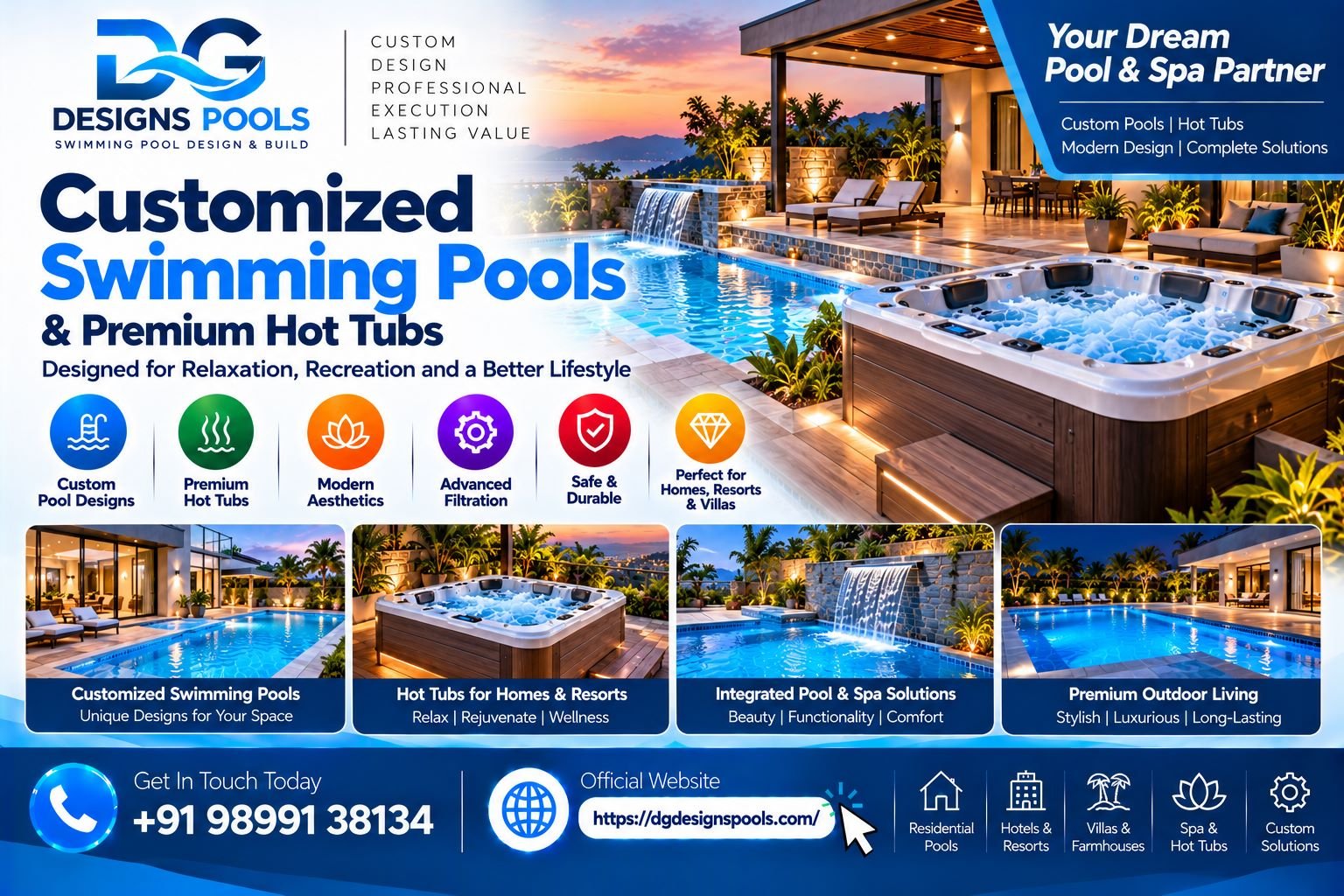
Swimming pool industry is experiencing increasing interest in multifunctional outdoor environments that combine recreation, relaxation, social interaction, and architectural design.
Homeowners, hospitality developers, and luxury property designers are exploring aquatic installations that offer more than a conventional swimming area.
Customized swimming pools provide opportunities to create personalised layouts with relaxation zones, decorative water features, comfortable seating, and integrated landscaping.
Meanwhile, professional hot tub manufacturers contribute specialised heated bathing systems that can complement swimming pool environments through suitable equipment and coordinated design.
Together, these solutions can support outdoor spaces designed around different activities, property requirements, and user preferences.
However, successful integration requires careful planning of circulation systems, temperature requirements, electrical safety, privacy, and maintenance accessibility.
Why Multifunctional Outdoor Pool Design Is Gaining Attention
Modern outdoor spaces are increasingly designed to support several recreational activities within one coordinated environment.
A residential garden may include a swimming pool for exercise, an adjoining spa for relaxation, and surrounding seating areas for social gatherings.
This approach allows property owners to make more purposeful use of available outdoor space.
However, different activities introduce different technical and safety requirements.
Designers should therefore consider how people will move between swimming, relaxation, and surrounding leisure areas.
What Are Customized Swimming Pools?
Customized swimming pools are designed according to the architectural characteristics, available space, and functional preferences of a particular property.
Unlike standard pool designs, customised installations may incorporate personalised dimensions, shapes, depths, seating arrangements, and decorative features.
Depending on engineering requirements, customisation may include shallow relaxation shelves, swimming lanes, integrated steps, or separate spa areas.
Materials and construction methods can vary according to the design.
However, customised features must remain compatible with structural requirements, circulation systems, and applicable safety standards.
A successful design balances individual preferences with practical construction considerations.
How Hot Tub Manufacturers Support Integrated Aquatic Spaces
Professional hot tub manufacturers develop heated bathing systems that may include seating, hydrotherapy-style jets, filtration equipment, and temperature controls.
These products can be installed as independent units or incorporated into appropriately designed outdoor leisure environments.
A separate hot tub may provide greater flexibility in controlling water temperature and maintaining specialised equipment.
An integrated pool-and-spa concept may offer coordinated visual presentation but requires careful hydraulic and structural planning.
The appropriate arrangement depends on property dimensions, usage expectations, installation requirements, and maintenance preferences.
Creating Separate Zones for Different Activities
One of the most important considerations in customised pool development is activity zoning.
Different users may prefer swimming, seated relaxation, or casual interaction.
A thoughtfully planned aquatic environment can provide separate areas for these activities.
For example, a residential installation may incorporate a swimming section, a shallow relaxation area, and a separate heated spa.
However, water depth, accessibility, and user safety must guide the arrangement.
A hot tub should not be placed where it creates hazards for swimmers or interferes with pool circulation.
Proper zoning can help improve usability while maintaining a cohesive architectural appearance.
Comparing Integrated and Separate Hot Tub Installations
Property owners may consider different approaches when combining swimming pools and heated bathing facilities.
| Design Factor | Integrated Pool and Spa | Separate Hot Tub |
| Appearance | Coordinated architectural design | Independent visual feature |
| Placement | Connected with the pool layout | Flexible within suitable spaces |
| Temperature Control | Depends on hydraulic design | Commonly independently controlled |
| Equipment | May involve coordinated systems | Typically has dedicated equipment |
| Maintenance | Requires clear system access | Requires separate servicing |
| Main Consideration | Engineering compatibility | Installation and accessibility |
Neither arrangement is automatically superior.
The appropriate choice depends on engineering feasibility, user preferences, and operational requirements.
Designing Privacy and Comfort into Outdoor Spaces
Privacy can influence how comfortably people use residential swimming pools and hot tubs.
Outdoor installations may be visible from nearby buildings, balconies, or surrounding properties.
Suitable landscaping, screening structures, and architectural positioning can help create more private environments.
However, privacy features should not obstruct essential ventilation, emergency access, or supervision.
Comfort also depends on available seating, appropriate walking surfaces, and practical access arrangements.
For smaller properties, thoughtful spatial planning may be more valuable than adding numerous decorative features.
Why Water Temperature and Circulation Matter
Swimming pools and hot tubs often operate under different temperature conditions.
Heated spa systems may require dedicated controls, circulation arrangements, and water-treatment procedures.
If the systems share equipment or plumbing connections, their compatibility must be carefully assessed.
Warm-water bathing also requires particular attention to hygiene and temperature safety.
Qualified specialists should establish suitable circulation, filtration, heating, and disinfection arrangements.
Equipment selection should be based on actual operating requirements rather than aesthetic preferences alone.
Managing Noise and Equipment Placement
Luxury outdoor environments should provide relaxation without unnecessary equipment disturbance.
Circulation pumps, water jets, heaters, and filtration systems may generate noise or vibration.
Poorly positioned equipment can affect nearby seating areas or surrounding residential spaces.
During design development, engineers should assess equipment location, ventilation, maintenance clearance, and suitable acoustic measures.
Electrical installations should also meet applicable safety requirements.
Considering these factors during planning can prevent difficulties after construction.
How Landscaping Complements Custom Pool Design
Landscaping plays an important role in connecting swimming pools with surrounding architecture.
Suitable paving, greenery, lighting, and outdoor furniture can help create a cohesive environment.
Decorative features should be selected according to the property’s character and maintenance requirements.
For example, carefully positioned lighting may improve visibility around access routes while supporting evening presentation.
However, electrical equipment near water requires appropriate protection and professional installation.
Landscaping materials should also be evaluated for drainage, slip resistance, and compatibility with pool maintenance activities.
Choosing the Right Pool and Hot Tub Development Partner
Businesses and homeowners planning customized swimming pools should evaluate technical expertise alongside creative design capabilities.
Important considerations include:
- Architectural Planning: Confirm that the proposed design suits the property.
- Engineering Evaluation: Assess structural and hydraulic requirements.
- Equipment Compatibility: Review filtration, heating, and circulation systems.
- Safety Provisions: Include appropriate access, drainage, and electrical protection.
- Maintenance Planning: Ensure equipment remains accessible for servicing.
- Project Documentation: Clarify material specifications, responsibilities, and warranty conditions.
Working with qualified specialists can support better coordination between swimming pool construction and hot tub installation.
Frequently Asked Questions (FAQs)
1. What are customized swimming pools?
Customized swimming pools are designed around specific property dimensions, architectural preferences, recreational needs, and engineering requirements.
2. Can a hot tub be included in a customized swimming pool design?
Yes. A hot tub can be integrated into a suitable pool development or installed separately, subject to structural, hydraulic, and safety considerations.
3. What services do hot tub manufacturers provide?
Depending on their capabilities, they may supply heated bathing units, integrated equipment, custom configurations, and technical installation guidance.
4. Are separate hot tubs easier to maintain than integrated spa systems?
Maintenance requirements vary. Separate systems may provide independent equipment access, while integrated installations require suitable coordination of their operating systems.
5. What should homeowners consider before designing a luxury pool and hot tub area?
They should evaluate space, structural conditions, intended activities, privacy, equipment requirements, water hygiene, safety, and long-term maintenance.
Media Contact
Department: Customized Swimming Pool and Hot Tub Design Enquiries
Contact: +91 98991 38134
Email: abhinav.mishra@hotmail.com
Official Website: https://dgdesignspools.com/
Read More:-