
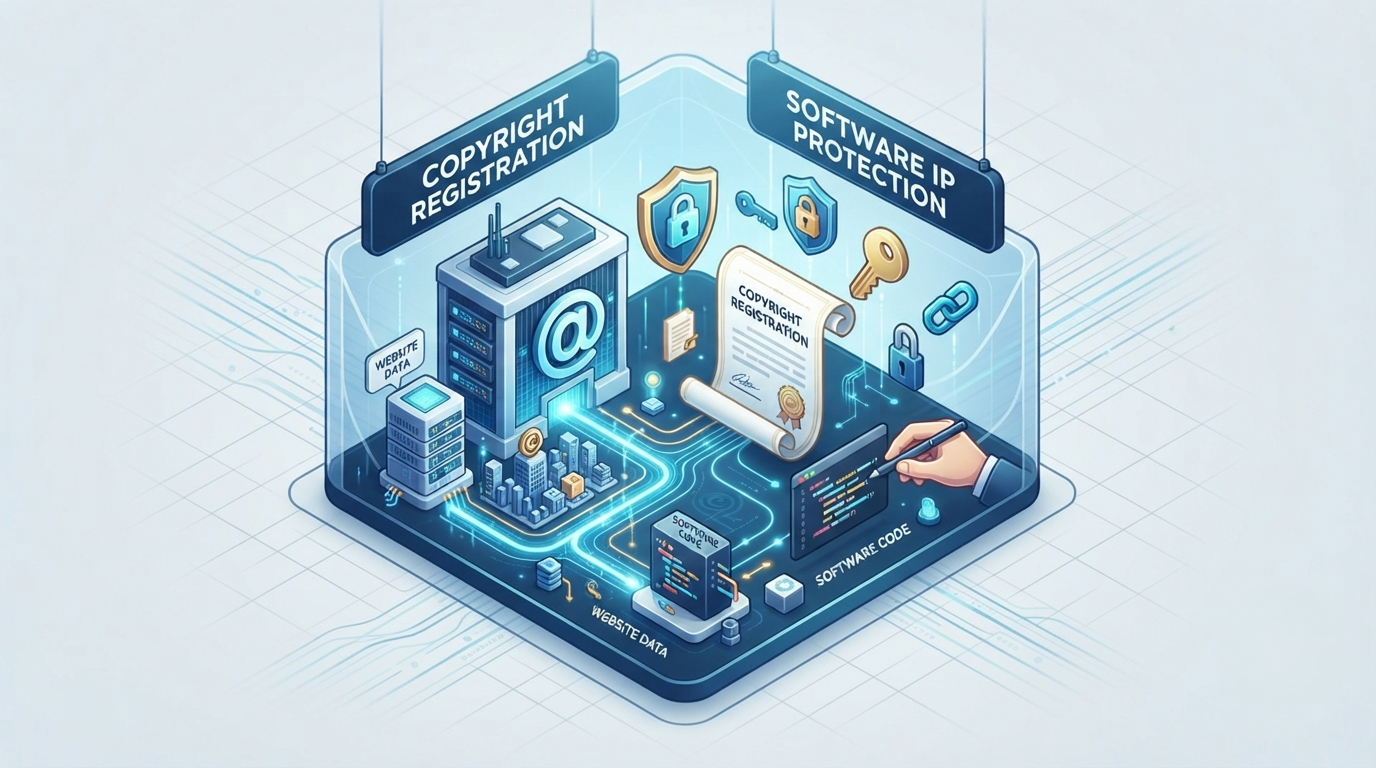
Websites and software are valuable business assets. Source code, interface graphics, written content, databases, photographs, documentation and customised digital features can represent years of investment. Yet these assets are also easy to copy, modify or distribute without permission. Copyright Registration for Website assets, combined with effective Software Intellectual Property Protection, can strengthen ownership records and help businesses respond more confidently to infringement.
Copyright protection generally arises automatically when an eligible original work is created and fixed in a recognised form. Under the Berne Convention framework, registration is not normally required simply for copyright to exist. However, many countries maintain voluntary registration systems that can provide useful evidence in ownership disputes and commercial transactions.
What Is Copyright Registration for Website Content?
A website is not necessarily protected as one single object. Different original components may receive copyright protection according to their nature.
Potentially protectable website elements include written articles, original photographs, illustrations, graphics, videos, software code and certain original databases or compilations. Copyright normally protects original expression rather than an underlying idea, business method, procedure, mathematical concept or functionality.
For example, another company generally cannot lawfully copy protected original website photographs or substantial original text simply because they are publicly accessible online.
A copyright registration application may therefore need to identify precisely which website components are being claimed.
Website Elements Commonly Considered for Protection
Businesses should review:
- Original website text and blog articles
- Custom illustrations and graphic designs
- Proprietary photographs and videos
- Original front-end and back-end source code
- Downloadable manuals, reports and documents
- Certain databases and original compilations
- Original UI artwork and visual content
Third-party themes, stock photographs, open-source components and licensed material normally cannot be claimed as exclusively created by the website owner unless the owner actually possesses the relevant rights.
What Is Software Intellectual Property Protection?
Software Intellectual Property Protection involves protecting the legally recognised intellectual assets within a software product.
Computer programs are generally treated as copyright-protected literary works internationally. WIPO explains that software can receive copyright protection automatically, although voluntary registration procedures differ between jurisdictions.
Copyright can protect original expression contained in source code and other qualifying software materials. It does not ordinarily create monopoly rights over abstract ideas, algorithms, systems, concepts or methods merely because they appear within a program. The U.S. Copyright Office similarly distinguishes copyrightable program expression from ideas, program logic, algorithms and methods.
Copyright Versus Other IP Protection
| Protection | Common Purpose | Possible Digital Asset |
| Copyright | Protect original expression | Code, text, graphics, documentation |
| Trademark | Protect brand identity | Brand name, product name, logo |
| Patent | Protect eligible inventions | Certain technical innovations |
| Trade Secret | Protect confidential information | Algorithms, processes, proprietary know-how |
A sophisticated software company may therefore use several intellectual property rights simultaneously.
Why Copyright Registration Can Matter
Although copyright may exist automatically, formal registration can create a clearer documentary record connecting a particular work with its claimant.
WIPO notes that voluntary registration systems can help resolve disputes concerning creation or ownership and may facilitate transactions, assignments and transfers of rights.
Registration may therefore be particularly valuable when software is commercially licensed, sold to investors, transferred during an acquisition or developed by multiple employees and contractors.
Business Benefits of Registration
Copyright registration can support:
- Documentation of ownership and authorship.
- Evidence showing what material was claimed at a particular time.
- Software licensing and commercial negotiations.
- Due diligence during investment or acquisition.
- Enforcement strategies when copying occurs.
- Record keeping for valuable intellectual property portfolios.
The exact legal advantages—including whether registration affects court procedures, damages or available remedies—depend on the relevant country’s legislation.
How to Prepare for Website or Software Copyright Registration
Before filing, conduct an intellectual property audit.
Step 1: Identify the Copyrightable Material
Separate proprietary content from third-party components. Determine who created the code, designs, photographs and written materials.
Step 2: Confirm Ownership
Do not automatically assume that paying a developer or freelancer means every copyright has transferred to your company. Examine employment agreements, development contracts, IP assignment clauses and licensing arrangements.
Step 3: Document Development
Maintain dated source-control records, design files, drafts, contracts and version histories. These records can help establish how the work developed and who participated.
Step 4: Select the Correct Registration Category
Classification differs between copyright offices. For example, the U.S. Copyright Office recognises computer programs, databases, blogs and websites within its digital-content registration resources, while registration may depend on the predominant type of authorship involved.
Step 5: Submit the Required Material
The relevant authority may require an application, claimant information, information about publication and an appropriate deposit or copy of the work.
Never send confidential source code unnecessarily. Check the applicable copyright office’s rules regarding deposits, redaction and treatment of trade-secret material before filing.
Copyright Protection for Frequently Updated Websites
Websites constantly change. New product descriptions, articles, images and code may be added every week.
One registration therefore should not automatically be assumed to protect every future update as a newly registered work. Businesses with continuously developing websites or SaaS platforms should establish an IP-management process that records significant new versions and considers whether additional registrations are commercially worthwhile.
Common Website and Software Copyright Mistakes
Businesses often weaken their position by failing to document ownership.
Typical problems include developers working without written IP assignments, copying stock assets without checking licences, confusing domain ownership with copyright ownership, claiming open-source software as proprietary code, failing to retain source-control records and assuming that a copyright notice itself creates ownership.
Another risk is using unofficial online “global copyright registration” services. WIPO specifically warns that unofficial services do not provide international copyright recognition merely because they issue private certificates.
Frequently Asked Questions
1. Is website copyright protection automatic?
Generally, eligible original material receives copyright protection automatically when created and fixed, although national laws determine the details.
2. Do I need copyright registration for my website?
Not necessarily for copyright to exist, but registration can provide valuable documentary and evidentiary benefits.
3. Can software source code be copyrighted?
Yes. Original computer-program expression can generally receive copyright protection.
4. Can an algorithm be copyrighted?
Copyright generally protects expression rather than the underlying algorithm, idea, procedure or method.
5. Can website design be copyrighted?
Original graphics, artwork, written material and some other expressive design elements may qualify, depending on applicable law and originality.
6. Does copyright protect my domain name?
A domain name itself should not be treated as ordinary copyright-protected website content. Other rights, including trademark law, may be more relevant.
7. Can I copyright a mobile application?
Yes. Copyright can potentially protect qualifying software code, graphics, text and other original components of an app.
8. Does registration protect future website updates?
Do not assume so. New material or materially revised versions may require separate consideration under the relevant registration system.
9. Can freelancers own copyright in work created for my company?
Potentially. Ownership depends on applicable law and contractual arrangements, making written IP assignment provisions important.
10. Is copyright registration valid worldwide?
There is no single worldwide WIPO copyright registration. Copyright protection is internationally supported through treaties, while registration systems remain national or jurisdiction-specific.