Modern engineering increasingly depends on materials that can perform reliably under conditions that would challenge ordinary metals and ceramics. Semiconductor processing, vacuum technology, high-temperature research and advanced scientific equipment can involve extreme heat, corrosive environments, strict purity requirements and unusual electrical demands.
Two materials that demonstrate how specialised modern material science has become are Pyrolytic Boron Nitride and Zirconium Foil.
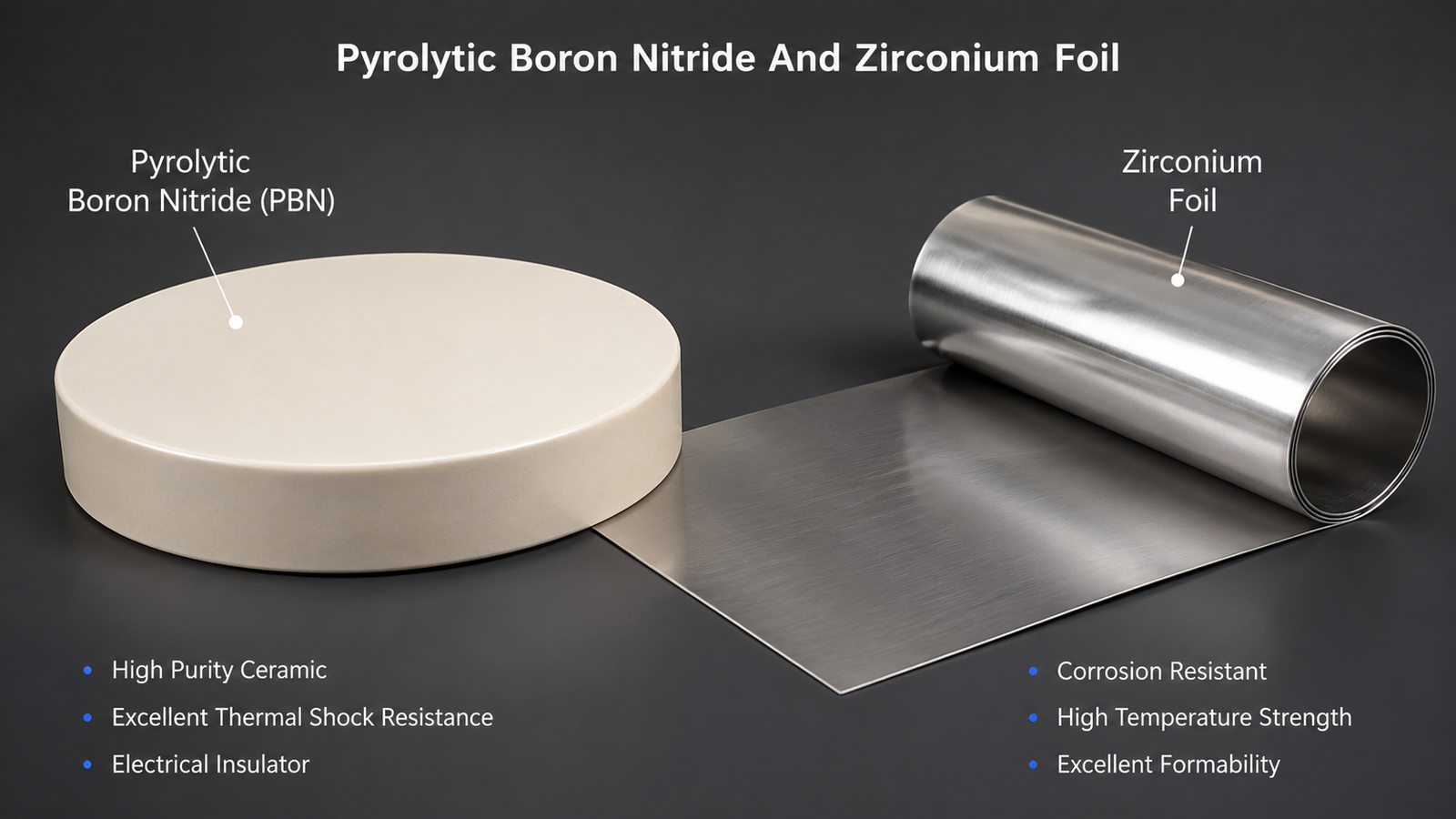
They belong to completely different material families. Pyrolytic Boron Nitride (PBN) is an advanced ceramic, while Zirconium Foil is a thin metallic material. Their importance lies not in competing with one another but in solving different engineering challenges.
Understanding where each material performs well can help engineers, researchers and procurement teams make better material-selection decisions.
Why Advanced Industries Need Specialised Materials
A material suitable for an everyday mechanical component may not work inside semiconductor processing equipment or a controlled vacuum system.
Advanced applications can demand several properties simultaneously, including:
- High-temperature stability
- Chemical resistance
- Electrical insulation or conductivity
- Low contamination
- Controlled thermal behaviour
- Precise dimensions
- Vacuum compatibility
- Reliable surface characteristics
This is where application-specific materials become valuable.
Instead of asking which material is strongest overall, engineers increasingly need to ask which material has the correct combination of properties for a particular operating environment.
What Makes Pyrolytic Boron Nitride Different?
Pyrolytic Boron Nitride is a specialised form of boron nitride typically produced using chemical vapour deposition.
Unlike conventional ceramic manufacturing, where powders may be pressed and sintered, PBN can be deposited under controlled conditions to create exceptionally pure material without traditional ceramic binders.
This is particularly useful for processes where contamination must be minimised.
PBN also possesses a layered structure. As a result, some of its properties vary according to direction, a characteristic known as anisotropy.
Its thermal behaviour is one of the best examples. Heat can travel much more effectively along certain directions than through others, giving equipment designers additional options for controlling heat flow.
Where Does Pyrolytic Boron Nitride Perform Best?
The combination of purity, thermal behaviour and electrical insulation makes Pyrolytic Boron Nitride especially attractive for semiconductor and high-temperature processing.
Common applications include:
- Semiconductor crystal-growth crucibles
- Evaporation boats
- Electrical insulating components
- Vacuum-processing fixtures
- Compound-semiconductor manufacturing
- High-purity material containers
- Thermal management components
- Specialised laboratory equipment
Its role in crystal growth is particularly interesting.
When high-purity semiconductor materials are being processed, the crucible itself must not introduce unacceptable contaminants. PBN’s purity and chemical characteristics can make it a suitable choice for specific crystal-growth processes.
Why Thermal Anisotropy Matters
Not all heat-management challenges require a material to conduct heat uniformly.
The layered structure of Pyrolytic Boron Nitride means its thermal conductivity differs significantly depending on direction.
This characteristic can be useful when designers want heat to spread efficiently across one direction while reducing transfer through another.
PBN simultaneously provides strong electrical insulation, creating an unusual combination of thermal management and dielectric performance.
Other important characteristics can include chemical stability, thermal-shock resistance and compatibility with specialised vacuum environments.
Zirconium Foil Solves a Different Engineering Problem
While PBN represents advanced ceramic technology, Zirconium Foil provides specialised metallic performance.
Zirconium is known particularly for its resistance to corrosion in many environments. When manufactured into thin foil, it becomes useful for scientific experiments and engineering applications requiring carefully controlled thickness and metallic surface characteristics.
Zirconium also has relatively low neutron absorption compared with many metals. This characteristic contributes significantly to the importance of zirconium-based materials in nuclear technology.
However, nuclear technology is only one part of the story.
Thin zirconium material can also provide a useful experimental platform for researchers studying corrosion, oxidation, diffusion and surface behaviour.
Why Use Zirconium as a Thin Foil?
A thin material behaves differently from a large structural component, particularly when surface reactions are important.
Zirconium Foil offers a comparatively high surface area relative to its material volume. Researchers can expose controlled foil specimens to different gases, temperatures or chemical environments and examine the resulting changes.
Potential applications include:
- Surface-science research
- Corrosion studies
- Nuclear-material experiments
- Oxidation testing
- Electrochemical investigations
- Vacuum research
- Thin-film development
- Diffusion experiments
- High-temperature testing
- Surface modification
For these applications, seemingly small specification differences can become significant.
Thickness, purity, composition and surface finish may all influence experimental behaviour.
Pyrolytic Boron Nitride vs Zirconium Foil
The fundamental differences become clearer through direct comparison.
| Feature | Pyrolytic Boron Nitride | Zirconium Foil |
| Material family | Advanced ceramic | Metal |
| Typical form | Crucibles and components | Thin foil or sheet |
| Electrical behaviour | Insulator | Conductor |
| Major characteristic | Purity and thermal anisotropy | Corrosion resistance |
| Mechanical form | Relatively rigid | Formable as thin foil |
| Semiconductor applications | Particularly relevant | Specialised |
| Surface research | Application specific | Highly relevant |
| Nuclear applications | Specialised | Important |
| Thermal behaviour | Direction dependent | Metallic heat transfer |
| Main selection focus | Purity and functional performance | Surface and metallic performance |
This comparison highlights an important point: these materials are not direct alternatives.
A project requiring electrical insulation may favour PBN, whereas an experiment requiring an electrically conductive metallic foil would require an entirely different solution.
What Should Engineers Consider Before Buying?
Selecting advanced materials by name alone can lead to unsuitable specifications.
For Pyrolytic Boron Nitride, buyers should consider purity, dimensions, component geometry, thermal orientation, operating atmosphere and temperature requirements.
For Zirconium Foil, factors such as grade, thickness, width, length, purity, surface condition and chemical composition deserve attention.
A practical selection process should examine:
- Maximum operating temperature
- Electrical requirements
- Chemical exposure
- Vacuum conditions
- Required purity
- Surface characteristics
- Mechanical loading
- Dimensional tolerances
Providing these details to a qualified material supplier can help narrow the available options considerably.
Frequently Asked Questions
1. What is Pyrolytic Boron Nitride?
It is a specialised boron nitride ceramic generally manufactured through chemical vapour deposition.
2. Why is PBN used in semiconductor applications?
Its purity, electrical insulation and thermal properties make it valuable for contamination-sensitive processing.
3. Is PBN electrically conductive?
No. It is primarily valued as an electrical insulator.
4. What is thermal anisotropy in PBN?
It means thermal conductivity changes according to the direction through the material.
5. What is Zirconium Foil?
It is zirconium metal manufactured into a thin, controlled foil format.
6. What is Zirconium Foil used for?
Applications include surface science, corrosion testing, nuclear research, oxidation studies and materials development.
7. Does zirconium resist corrosion?
Yes. Strong corrosion resistance in many environments is an important characteristic of zirconium.
8. Why is zirconium relevant to nuclear applications?
Its relatively low neutron absorption contributes to its usefulness in nuclear technology.
9. Can PBN and zirconium foil be used interchangeably?
No. One is an insulating ceramic and the other is a conductive metal.
10. Does material purity matter?
Yes. Purity can be particularly important in semiconductor, vacuum, nuclear and scientific research applications.
Read more – https://newsgrow.blogspot.com/2026/09/boron-nitride-crucibles-and-boron.html
https://newsgrow.blogspot.com/2026/09/pyrolytic-boron-nitride-and-zirconium.html