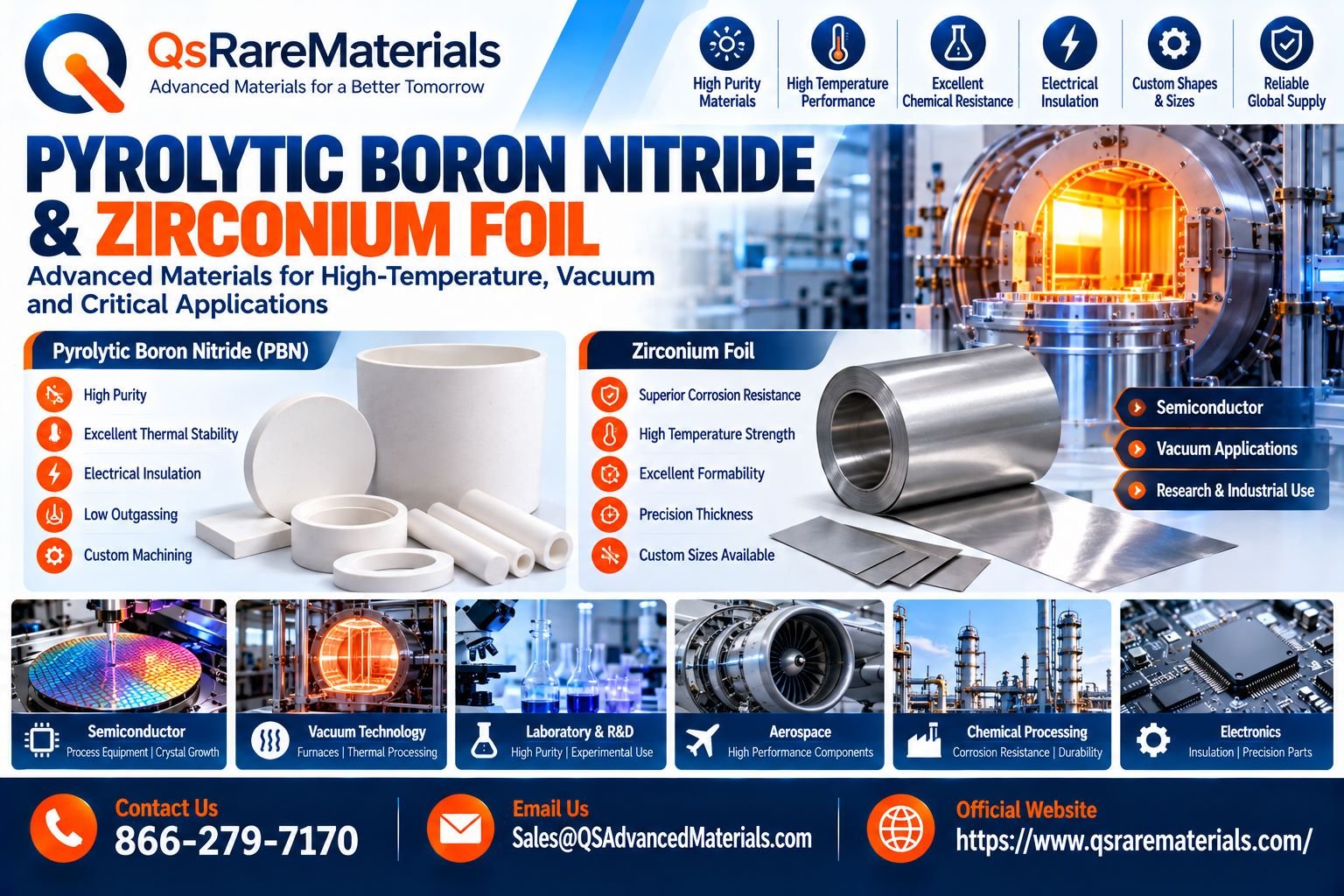
In coating research, the interaction between a deposited layer and its underlying material can influence adhesion, chemical stability, and functional performance. Researchers must therefore consider substrate preparation, thermal behaviour, processing equipment, and contamination risks.
Pyrolytic Boron Nitride offers high-purity ceramic properties suitable for selected insulation and material containment applications in specialised processing systems.
Meanwhile, Zirconium Foil provides a thin metallic substrate that can be investigated in surface modification, coating adhesion, and material compatibility experiments.
Although these materials perform different functions, understanding their properties can help researchers develop more controlled experimental arrangements.
Why Surface Engineering Requires Careful Material Selection
Surface engineering involves modifying material surfaces to achieve particular functional characteristics.
Applications may include corrosion protection, improved wear resistance, electrical performance, and specialised chemical behaviour.
However, coating effectiveness depends on several factors beyond the deposited material.
The substrate’s surface condition, chemical composition, and processing environment can affect the resulting interface.
Researchers should therefore evaluate equipment materials and specimen preparation before conducting critical experiments.
What Is Pyrolytic Boron Nitride?
Pyrolytic Boron Nitride, commonly called PBN, is a specialised ceramic generally manufactured through chemical vapour deposition.
Its layered crystal structure contributes to distinctive thermal characteristics and electrical insulation properties.
PBN can be manufactured with high purity, making it useful in selected research and thermal processing applications where material contamination is a concern.
Depending on equipment requirements, PBN components may serve as crucibles, insulating elements, or specialised processing fixtures.
However, material performance depends on temperature, atmosphere, and chemical compatibility.
Exposure to oxidising conditions at elevated temperatures can limit its suitability.
Understanding Zirconium Foil in Coating Research
Zirconium Foil is a thin metallic sheet produced from zirconium or a specified zirconium-based grade.
Zirconium is recognised for corrosion resistance in certain environments and its ability to form an oxide layer on exposed surfaces.
These characteristics make zirconium relevant to selected investigations involving surface chemistry and protective coatings.
Researchers may use foil specimens to examine coating adhesion, oxidation behaviour, or interactions between metallic substrates and deposited materials.
However, the results depend on foil thickness, surface condition, coating composition, and experimental procedures.
Not every coating method is suitable for zirconium.
The Importance of Substrate Preparation
A coating must interact with the surface of the underlying material.
Contaminants, oxidation, scratches, or inconsistent surface roughness can influence adhesion and experimental results.
When preparing zirconium foil specimens, researchers should follow controlled handling and cleaning procedures.
Surface preparation must also be appropriate for the proposed coating technique.
Aggressive mechanical treatment may deform thin specimens.
Documenting preparation methods helps laboratories compare experimental results more effectively.
Comparing Ceramic and Metallic Material Functions
| Evaluation Factor | Pyrolytic Boron Nitride | Zirconium Foil |
| Material Category | Technical ceramic | Metallic material |
| Electrical Behaviour | Generally insulating | Conductive |
| Typical Research Function | Processing fixtures and insulation | Metallic test substrate |
| Important Property | High purity and anisotropic thermal behaviour | Surface chemistry and corrosion characteristics |
| Mechanical Consideration | Brittle structure | Thin-sheet deformation |
| Main Limitation | Atmosphere and chemical compatibility | Oxidation and reactive processing conditions |
The materials should be evaluated independently before incorporation into a research system.
How Processing Equipment Influences Coating Quality
Coating experiments may involve vacuum chambers, heating elements, material sources, and specimen holders.
Each component must be compatible with the intended process.
For suitable thermal evaporation applications, high-purity ceramic containment components may help reduce certain contamination risks.
PBN can provide useful properties for selected containment or insulation functions.
However, it is not universally compatible with every source material.
Researchers should verify the proposed equipment arrangement through technical specifications and representative trials.
Suitable processing equipment supports more controlled experimentation without guaranteeing a particular coating result.
Managing Thermal Expansion Differences
Materials expand and contract when exposed to temperature changes.
During coating processes involving heating, different materials may experience different dimensional changes.
Zirconium foil and deposited coating materials can have different thermal expansion characteristics.
These differences may contribute to internal stresses, cracking, or coating separation.
Fixture materials can also influence specimen positioning.
Engineers should evaluate thermal behaviour and suitable support arrangements.
The objective is to avoid unnecessary mechanical restraint while maintaining the required experimental geometry.
Preventing Contamination During Deposition
Contamination can influence coating composition, adhesion, and surface characteristics.
Potential sources include handling tools, processing equipment, residual substances, and unsuitable containers.
High-purity ceramics may help manage selected contamination risks when they are compatible with the application.
However, material purity alone does not establish a contamination-free process.
Laboratories should define appropriate cleaning, storage, and equipment inspection procedures.
Material documentation also helps researchers identify potential sources of experimental variation.
Measuring Coating Performance
After coating, researchers may evaluate specimens using appropriate analytical methods.
Depending on the research objective, relevant assessments can include coating thickness, surface appearance, adhesion, and chemical composition.
Microscopy or other suitable surface analysis techniques may provide additional information.
Testing should reflect the intended function of the coating.
For example, a protective coating requires different evaluation criteria from a layer developed for electrical or optical performance.
Results should be interpreted alongside the substrate’s original condition and the processing parameters.
Selecting Materials for Custom Research Systems
Specialised research equipment frequently requires components with nonstandard dimensions.
PBN fixtures may need particular geometries, while zirconium foil specimens may require controlled thickness or surface specifications.
Before ordering, researchers should establish:
- Required material purity and composition.
- Component dimensions and tolerances.
- Intended temperature and atmosphere.
- Electrical and mechanical requirements.
- Surface condition and handling specifications.
- Relevant quality-control documentation.
Clear specifications support accurate procurement and more dependable experimental planning.
Frequently Asked Questions (FAQs)
1. What is Pyrolytic Boron Nitride?
Pyrolytic boron nitride is a high-purity technical ceramic generally produced through chemical vapour deposition and used in specialised thermal and electrical applications.
2. What is Zirconium Foil used for?
Zirconium foil may be used in materials research, surface engineering, coating experiments, and specialised applications requiring thin zirconium metal.
3. Can PBN components be used in coating equipment?
Certain PBN components may be suitable for selected processing and insulation applications, depending on temperature, atmosphere, and material compatibility.
4. Why is zirconium foil surface preparation important?
Surface preparation helps control contamination, roughness, and other factors that may influence coating adhesion and experimental consistency.
5. How should researchers select advanced ceramic and metallic materials?
Researchers should evaluate verified composition, purity, dimensions, thermal behaviour, chemical compatibility, and suitable quality documentation.
Media Contact
Department: Advanced Ceramics and Specialty Materials Enquiries
Phone: 866-279-7170
Email: Sales@QSAdvancedMaterials.com
Official Website: https://www.qsrarematerials.com/